Bamboo leaf sticky rice dumplings (banh u la tre)
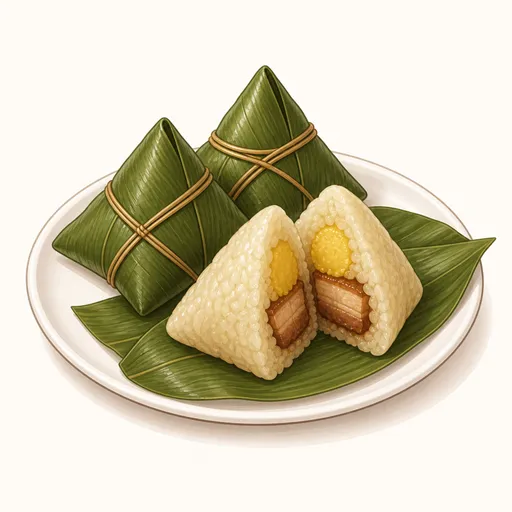
Banh u la tre are dainty three-sided pyramids of sticky rice wrapped in green bamboo leaves and boiled for hours, usually made for the Duanwu Festival. They are chewy and fragrant with bamboo leaf, filled with rich, nutty mung beans and a savory piece of pork belly marinated in five-spice.
- Difficulty
- Hard
- Prep
- 1 hr 30 min
- Cook
- 2 hr 30 min
- Rising or chilling
- 6 hr
- Total time
- 10 hr
- Method
- Boiled or simmered
Ingredients
Glutinous rice
Mung bean and pork filling
Wrapping leaves
Instructions
Step 1
Rinse 500 g glutinous rice and 150 g split peeled mung beans, soak them separately in water for about six hours, then drain. Rice and beans that have soaked long enough cook evenly in the pot without a hard center. The rice is ready when it crumbles with a light squeeze, and the beans are plump with all their skins slipped off.
Step 2
Cut 200 g pork belly into finger-length pieces and marinate them with 20 g minced shallots, 10 g fish sauce, 5 g granulated sugar, a pinch ground black pepper and a pinch five-spice powder for about 30 minutes. Five-spice gives a signature aroma and masks any porky smell. The pork is ready when the seasoning has soaked in evenly, the surface has firmed slightly and it smells fragrant.
Step 3
Steam the mung beans for about 20 minutes until just cooked, then mash them and roll them into small balls about the size of your thumb. Pre-steaming the beans keeps the filling from staying hard even in such small dumplings. The beans are ready when they are soft and crumbly and roll into firm balls that do not crack.
Step 4
Toss the drained glutinous rice with 5 g salt and 15 g vegetable oil until evenly coated. The salt seasons the rice shell, and the oil makes the grains glossy and keeps them from sticking to the leaves when unwrapped. The rice is ready when every grain has a light sheen and the grains stay separate.
Step 5
Soak 120 g bamboo leaves in hot water until soft, wash each leaf, wipe it dry and trim off the tough stem end. Only soft, pliable leaves can be folded into a cone without tearing. The leaves are ready when they fold in half without cracking and are clean and glossy green.
Step 6
Overlap two bamboo leaves, fold them into a triangular cone, add a layer of rice, place a bean ball and a piece of pork, cover with more rice, then fold the leaves over to seal and tie tightly with string. Wrapping firmly gives the dumplings sharp pyramid edges and keeps the rice from turning mushy during the long boil. The dumplings are ready when all three edges are well defined, they feel firm and not a single grain of rice escapes.
Step 7
Arrange the dumplings in a large pot, add water to cover them completely, bring to a boil and keep it over medium heat for about two and a half hours, topping up often with boiling water. A long boil cooks the glutinous rice until very tender and fuses the grains tightly together. They are done when an unwrapped test dumpling shows translucent, chewy rice and the bamboo leaf aroma comes through.
Step 8
Lift out the dumplings, rinse them quickly in cold water, then hang them up to drain and cool for about 30 minutes. Cold water firms the dumplings, and hanging them keeps water from pooling inside the leaves and turning them sour. They are ready when the leaves are dry and the dumplings feel firm, not soft or mushy, when you pick them up.
Equipment
- Small saucepan
- Steamer
- Kitchen twine
- Mixing bowl
- Kitchen scale
Tips
- If you do not have bamboo leaves, you can use dong leaves or banana leaves, though the aroma will be different.
- You can make vegetarian banh u by leaving out the pork and adding boiled peanuts to the filling.
- Top up with boiling water, never cold, so the pot keeps boiling and the dumplings do not end up undercooked.
Storage
Bamboo leaf dumplings keep for two days in a cool, airy place and about a week in the fridge. Before eating, steam them for about fifteen minutes so the rice turns soft and chewy again.
Common problems and how to fix them
- The rice inside is still hard and not chewy.
- The rice did not soak long enough or the pot ran low on water while cooking. Soak the rice longer, always keep the water above the dumplings and cook for about thirty more minutes.
- The leaves come open and the dumplings turn mushy.
- The dumplings were not wrapped tightly enough or the string was loose. Fold the leaves closed fully and tie them more firmly in your next batches.
This recipe is based on the common ratios for this bake and is written entirely in our own words.