Floating sticky rice balls (banh troi)
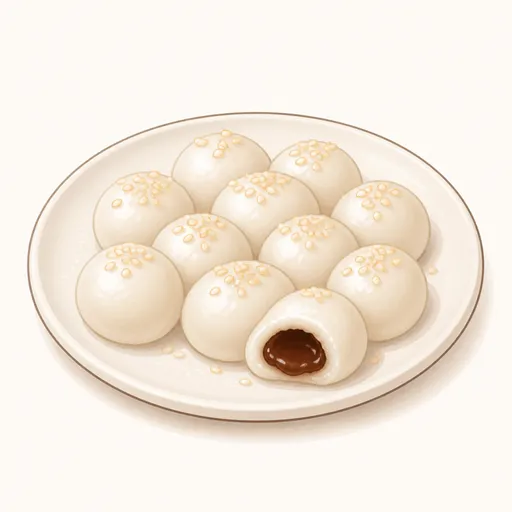
Banh troi are dainty little glutinous rice balls, each hiding a piece of palm sugar that melts into syrup when you bite in. They are traditionally made for the Cold Food Festival on the third day of the third lunar month, with a soft, chewy skin and a sprinkle of nutty toasted sesame, and they come together quickly with just a few simple ingredients.
- Difficulty
- Easy
- Prep
- 40 min
- Cook
- 20 min
- Rising or chilling
- 15 min
- Total time
- 1 hr 15 min
- Method
- Boiled or simmered
Ingredients
Glutinous rice dough
Sugar filling
Sesame topping
Instructions
Step 1
Put 300 g glutinous rice flour in a bowl, add 230 g warm water a little at a time and knead by hand. Adding the water gradually lets you stop at the right moment, since every brand of glutinous rice flour absorbs water differently. The dough is ready when it is soft and smooth, rolls into a ball without cracking at the edges and does not stick to your palms.
Step 2
Wrap the dough tightly in plastic wrap and leave it at room temperature for about 15 minutes. A short rest lets the water soak into every grain of flour, so the skins are chewy and do not crack. The dough is ready when it feels softer when pressed and the surface is smooth.
Step 3
Cut 90 g palm sugar from the block into small cubes about the size of a corn kernel. Small cubes give just enough sweetness and melt completely during boiling without splitting the skin. The sugar is ready when the cubes are evenly sized with no large shards left.
Step 4
Toast 15 g white sesame seeds in a dry pan over low heat, stirring constantly, for a few minutes. Low heat cooks the seeds evenly all the way through and brings out their aroma without turning them bitter. The sesame is ready when it turns ivory gold and a few seeds start to pop.
Step 5
Pinch off a piece of dough about the size of your thumb tip, flatten it, set a sugar cube in the center, then gather the edges together and roll it between your palms into a ball. A fully sealed skin keeps the melted sugar inside while boiling. The balls are ready when they are smooth and round, with no sugar showing and no cracks.
Step 6
Bring a large pot of water to a boil, drop in the balls one at a time and gently stir the bottom of the pot so they do not stick, keeping the heat at medium for about five minutes. Plenty of water gives the balls room to roll and cook evenly. They are done once they have floated to the surface for about another minute and the skins look more translucent.
Step 7
Lift the balls out with a slotted spoon and drop them straight into a bowl of cold water for about a minute. The cold water firms up the rice skin so the balls do not stick together and stay perfectly round. They are ready when the skins are glossy and taut and the balls do not slump when you pick them up.
Step 8
Transfer the balls to a plate moistened with a little water, spacing them slightly apart, then sprinkle the toasted sesame evenly over the top. Spacing them out lets them cool without clumping together. They are ready when the skins are chewy and the sugar inside has melted into syrup when you bite in.
Equipment
- Small saucepan
- Mixing bowl
- Kitchen scale
- Plastic wrap
Tips
- If you can find northern Vietnamese brown slab sugar, you can use it instead of palm sugar for a more traditional flavor.
- You can replace part of the water with pandan juice or butterfly pea flower tea to make balls in several colors.
- While shaping, keep the unused dough under a damp towel so the surface does not dry out and crack.
Storage
Banh troi is best on the day it is made, kept covered at room temperature. Avoid the fridge, because the rice skin will harden; if you have leftovers, boil them again briefly for a minute to soften them.
Common problems and how to fix them
- The balls burst while boiling and the sugar leaks into the pot.
- The skin was too thin or not sealed properly. Use a slightly larger piece of dough and roll the gathered seam carefully before dropping the balls into the water.
- The skin cracks while shaping.
- The dough is short on water or has dried out. Knead in a few drops of warm water and always keep a damp towel over the unused dough.
This recipe is based on the common ratios for this bake and is written entirely in our own words.