Sticky rice New Year cake (banh to)
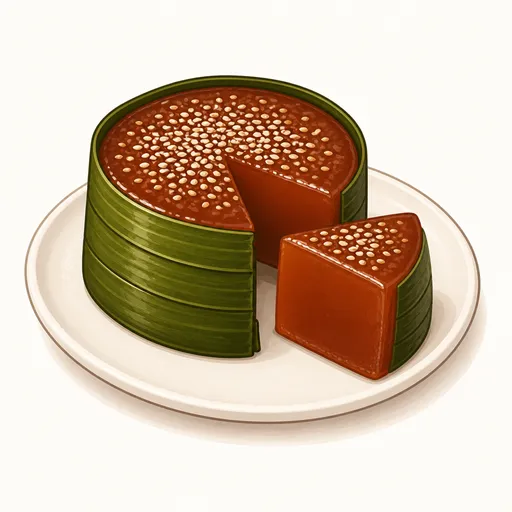
Banh to is a beloved Lunar New Year cake from Quang Nam and Hoi An, made from glutinous rice flour with brown sugar and ginger and steamed for many hours in a banana-leaf-lined pan. It turns a deep amber, dense and chewy, with a deep sweetness and the warm bite of ginger under a scattering of fragrant white sesame. Besides eating it at room temperature, people also cut it into thin slices to fry or sandwich between grilled rice crackers.
- Difficulty
- Medium
- Prep
- 30 min
- Cook
- 6 hr
- Rising or chilling
- 8 hr
- Total time
- 14 hr 30 min
- Method
- Steamed
Ingredients
Ginger syrup
Glutinous rice batter
Topping
Lining the pan
Instructions
Step 1
Put 400 g brown sugar, 260 g water and 20 g smashed fresh ginger in a pot and simmer over medium heat for about ten minutes, until the sugar dissolves and the ginger releases its flavor. Simmering long enough gives the syrup a gentle spicy aroma and a lovely brown color from the start. The syrup is ready when it is slightly thick, clear and smells distinctly of ginger.
Step 2
Turn off the heat, remove the ginger and let the syrup cool completely at room temperature for about an hour. Hot syrup would partly cook the rice flour in patches and make it lumpy when mixed. The syrup is ready when the side of the pot feels cool to the touch.
Step 3
Sift 500 g glutinous rice flour into a bowl, pour in the cooled syrup a little at a time and whisk steadily until all of it is used. Adding it gradually dissolves the flour completely so no little lumps form. The batter is ready when it is as thick as honey, smooth and pours in a slow stream when you lift the whisk.
Step 4
Soften banana leaves over a flame and cut them into strips to line the bottom and sides of an 18 cm round pan, glossy side facing in, then brush with a very thin layer of vegetable oil (to taste). The banana leaves keep the cake from sticking to the pan and give the crust a gentle fragrance. The pan is ready when the leaves cover it completely with no gaps at the bottom.
Step 5
Pour the batter into the pan, tap it gently a few times to bring air bubbles to the surface, then sprinkle 15 g white sesame seeds evenly over the top. Any trapped air bubbles would leave holes in the cake. The pan is ready when the surface is flat and still and covered with a thin, even layer of sesame.
Step 6
Set the pan in a steamer over boiling water, wrap the lid with a leaf or towel so condensation does not drip down, and steam steadily over medium heat for about six hours, topping up with boiling water every hour. The long steam darkens the sugar and cooks the rice flour dense and chewy right to the center. The cake is done when the whole thing has turned a translucent brown and a chopstick pushed into the center comes out with only a thin, glossy film.
Step 7
Lift out the pan and let the cake cool naturally overnight, about eight hours, in a cool, airy spot without covering it tightly. The hot cake is very soft and sticky and needs time to set into a firm block. It is ready when the surface is dry and it feels springy without dimpling when lightly pressed.
Step 8
Turn the cake out of the pan, peel off the leaves and cut it into slices about one centimeter thick with an oiled knife or a piece of thread. An oiled knife or thread gives flat slices without dragging or sticking. The slices are ready when the cut surface is glossy amber, chewy and holds its shape.
Equipment
- Steamer
- Round cake pan
- Small saucepan
- Whisk
- Sieve
- Mixing bowl
- Kitchen scale
Tips
- For a darker, more fragrant cake, you can replace part of the brown sugar with dark muscovado or palm sugar.
- Slices that have firmed up after a few days are delicious dipped in tempura batter and fried until golden, or sandwiched between two grilled sesame rice crackers.
- Use a large steamer and keep a kettle of boiling water nearby for topping up, so the pot never runs dry during the long steam.
Storage
Wrapped tightly, banh to keeps for about a week in a cool, dry place and even longer in the fridge. Once it hardens, just steam it for a few minutes or fry thin slices and it will be soft and chewy again.
Common problems and how to fix them
- The inside is cloudy white and still raw in the middle.
- The cake was not steamed long enough or the pot ran dry partway through. Steam it for another one to two hours and keep the water at a steady boil.
- The top of the cake is pitted and has water pooled on it.
- Condensation from the lid dripped onto the cake. Next time wrap the lid in a clean towel or lay a leaf over the top of the pan.
This recipe is based on the common ratios for this bake and is written entirely in our own words.