Cylindrical sticky rice cake (banh tet)
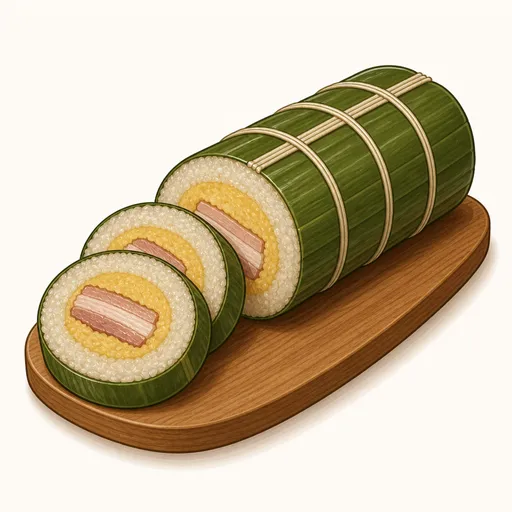
Banh tet is a log-shaped sticky rice cake wrapped in banana leaves, a familiar sight on Lunar New Year altars in southern and central Vietnam. The glutinous rice is briefly stir-cooked with coconut milk so it turns rich, fragrant and glossy, and inside sits a golden mung bean core hugging a strip of pork belly, which looks wonderful when you cut the cake into rounds.
- Difficulty
- Hard
- Prep
- 1 hr 30 min
- Cook
- 9 hr
- Rising or chilling
- 10 hr
- Total time
- 20 hr 30 min
- Method
- Boiled or simmered
Ingredients
Coconut sticky rice
Mung bean and pork filling
Banana leaves for wrapping
Instructions
Step 1
Rinse 1,000 g glutinous rice until the water runs clear and soak it for about six hours, and at the same time soak 300 g split peeled mung beans in a separate bowl of warm water. Soaking ahead lets the rice and beans absorb water evenly, shortens the boiling time and keeps the center of the cake from staying raw. Both are ready when the rice grains are opaque white and snap with a light press, and the beans have softened.
Step 2
Cut 400 g pork belly into long strips the length of the cake, toss them with 20 g finely minced shallots, 10 g fish sauce and 2 g ground black pepper, and let them marinate for about an hour. Long strips sit neatly in the middle of the filling, so every slice gets some pork. The pork is ready when the seasoning clings evenly and the meat has firmed slightly.
Step 3
Drain the mung beans, mix them with 3 g salt and steam them for about twenty minutes, then mash them smooth and shape them into two logs as long as the cake. Pre-steamed beans make a firm core that does not crumble when the cake cools. The beans are ready when they smear smoothly under a spoon and the logs hold their shape when lifted.
Step 4
Drain the rice very well and put it in a large pan with 200 g coconut milk, 15 g granulated sugar and 10 g salt, then stir it over low heat for about ten minutes. This quick stir-cook lets the rice soak up the richness of the coconut and makes the boiled cake glossier and more tender. The rice is ready when it has absorbed all the coconut milk and the grains stick together slightly.
Step 5
Wipe 500 g banana leaves clean, tear them into wide sheets, then blanch them quickly in boiling water or pass them over a flame until pliable. Softened leaves will not crack when rolled and wrap snugly around the cake. The leaves are ready when they turn a deep, glossy green and fold without breaking.
Step 6
Stack three or four leaves, spread half the rice into a strip, lay a bean log and a strip of pork down the middle and cover with more rice, then roll it tightly into a tube, fold both ends closed and tie string evenly along the length of the cake. Rolling tightly keeps the cake evenly round and stops the boiling water from seeping in. The cake is ready when it feels hard and solid, does not give when pressed and both ends are fully sealed.
Step 7
Place the cakes in a pot, cover them with water and boil over medium heat for about nine hours, checking every hour and topping up with hot water, and turn the cakes once halfway through. Steady heat and water that always covers the cakes cook the rice thoroughly from the outside in. The cakes are done when a test cake cut open shows translucent, dense and tender rice and a golden, cooked mung bean filling.
Step 8
Lift out the cakes, dip them in cold water to rinse off the slippery film, then hang them up or stand them upright in a cool, airy spot for about four hours to drain and cool completely. Hanging lets all the water drain away and the cakes firm up, so they slice without sticking to the knife. They are ready when the leaves are dry on the surface, cool to the touch and the cakes feel firm.
Equipment
- Deep skillet
- Nonstick skillet
- Kitchen twine
- Mixing bowl
- Steamer
- Sieve
- Kitchen scale
Tips
- Use the tying string itself to slice the cake into rounds, and you will get smooth, even slices that do not stick the way they do with a knife.
- Choose sturdy, fragrant leaves from varieties such as Thai or seeded bananas, which tear less than thin leaves.
- You can stir a little cooked black beans into the rice to make black bean banh tet; just reduce the rice by the same amount.
Storage
Hung in a cool, dry, airy place, banh tet keeps for about five days. To keep it longer, wrap it tightly and refrigerate it for about ten days; to serve, steam it again until soft or pan-fry slices until golden on both sides.
Common problems and how to fix them
- The center of the cake is still raw or has hard grains of rice.
- The cake was too thick or was not boiled long enough. Roll slightly thinner cakes and boil them for one to two hours longer, keeping the water at a steady boil.
- The cake is waterlogged, the rice is mushy and tastes bland.
- Torn leaves or loose string let the boiling water in. Check the leaves carefully before wrapping, use at least three layers and tie the string closer together.
This recipe is based on the common ratios for this bake and is written entirely in our own words.