Purple sticky rice cake (banh tet la cam)
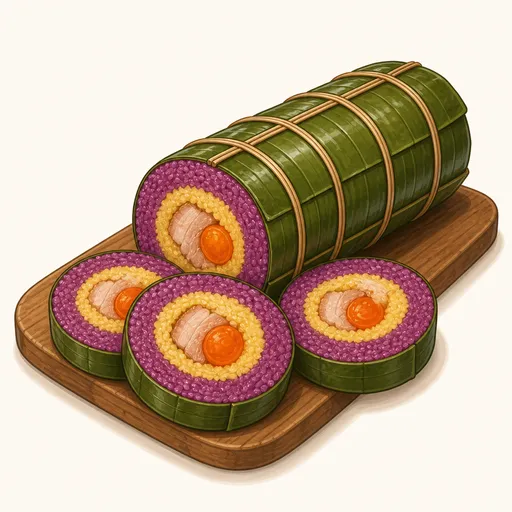
Banh tet la cam is a Lunar New Year specialty of the Mekong Delta, best known in Can Tho, with a layer of pinkish-purple sticky rice dyed entirely naturally with magenta plant leaves. Inside the log are nutty mung beans, rich pork belly and savory salted egg yolk, so each round you cut shows lovely rings of purple, yellow and orange.
- Difficulty
- Hard
- Prep
- 1 hr 40 min
- Cook
- 8 hr
- Rising or chilling
- 12 hr
- Total time
- 21 hr 40 min
- Method
- Boiled or simmered
Ingredients
Magenta leaf dye
Sticky rice
Mung bean, pork and salted egg filling
Banana leaves for wrapping
Instructions
Step 1
Wash 100 g magenta plant leaves, crumple them lightly and put them in a pot with 1,000 g water, simmer over medium heat for about twenty minutes, then strain out the leaves. Simmering just long enough releases all the purple pigment without clouding the liquid. The dye is ready when it is as dark purple as ink and the leaves in the pot have lost most of their color.
Step 2
Rinse 1,000 g glutinous rice, drain it, then soak it fully submerged in the cooled magenta dye for about eight hours or overnight. A long soak lets the purple color reach the very center of each grain and gives the rice enough water to cook evenly. The rice is ready when a broken grain is evenly purple all the way through and crumbles with a light squeeze.
Step 3
Cut 400 g pork belly into long strips the length of the cake and marinate them with 20 g minced shallots, 10 g fish sauce and 2 g ground black pepper for about an hour. That is enough time for the seasoning to soak into the meat, keeping the filling flavorful through the long boil. The pork is ready when the surface has firmed and taken on the dark color of the fish sauce.
Step 4
Soak 300 g split peeled mung beans for about two hours to soften, drain them, mix with 3 g salt, steam for about twenty minutes and press them into two long logs. Steaming the beans first makes the core smooth and creamy and ensures it is cooked by the time the rice is done. The beans are ready when they smear smoothly between two fingers and the logs hold their shape when picked up.
Step 5
Drain the rice well from the dye and put it in a pan with 200 g coconut milk, 20 g granulated sugar and 10 g salt, stirring gently over low heat for about eight minutes. The coconut milk coats every grain, making the cake rich and fragrant and giving the purple a glossy sheen after boiling. The rice is ready when the pan is dry, the grains stick together slightly and have a faint shine.
Step 6
Wipe 500 g banana leaves clean, cut them into sheets about thirty centimeters wide, then wilt them in the sun or pass them quickly over the stove. Wilted leaves are more pliable, so they wrap tightly around the cake without cracking or tearing. The leaves are ready when they turn deep green, look glossy and fold in half without a crackling sound.
Step 7
Stack three layers of leaves, spread half the rice into a strip, lay a bean log, a strip of pork and 60 g salted egg yolks end to end down the middle, cover with the remaining rice, roll it up firmly, fold both ends closed and tie it with many evenly spaced loops of string. A tight roll is what keeps the cake round, the rice compact and the boiling water out. The cake is ready when it feels hard in your hand, does not dent when pressed and both ends are sealed.
Step 8
Lay the cakes flat in a large pot, add water to cover them completely and boil over medium heat for about eight hours, topping up with boiling water now and then and turning the cakes once at the halfway point. Keeping the water above the cakes and at a gentle boil carries the heat evenly into the very center. The cakes are done when a test cake cut open shows translucent, dense, tender rice and a golden, cooked mung bean layer.
Step 9
Lift out the cakes, rinse them quickly under cold running water to remove the slippery film, then hang them in a breezy spot for about four hours. Cooling slowly lets the cakes drain, firm up and slice cleanly. They are ready when the banana leaves are dry on the surface and the cakes are cool and firm.
Equipment
- Deep skillet
- Small saucepan
- Nonstick skillet
- Steamer
- Sieve
- Kitchen twine
- Mixing bowl
- Kitchen scale
Tips
- Fresh magenta leaves give the best color, but you can use dried leaves at about one third of the amount, soaking them in warm water for ten minutes before simmering.
- A few drops of lime juice in the dye turn the color bright pink, while leaving it as is gives a deeper purple, so choose whichever you like.
- Wrap one extra outer layer of banana leaf with the glossy side facing out to make the cake look green and pretty and easier to unwrap.
Storage
Hung in a dry, airy place, the cakes keep for about five days in cool weather. To keep them longer, wrap each cake tightly and refrigerate for up to ten days; to serve, steam for about fifteen minutes or slice and pan-fry until crisp on both sides.
Common problems and how to fix them
- The color is pale and patchy, purple in some spots and white in others.
- The magenta dye was too weak or the rice did not soak long enough. Next time use more leaves, simmer a few minutes longer and soak the rice overnight, stirring it once or twice during the soak.
- The cake is mushy and watery inside when you cut it.
- Torn leaves or loose string let the boiling water seep in. Check the leaves before wrapping, use a full three layers and tie the loops of string closer together.
- The core is still undercooked even though the outside is done.
- The cake was too thick for the boiling time, or the water ran low at some point. Boil for about one more hour and keep topping up with boiling water so the pot does not lose heat.
This recipe is based on the common ratios for this bake and is written entirely in our own words.