Rice flour dumplings in dong leaves (banh te)
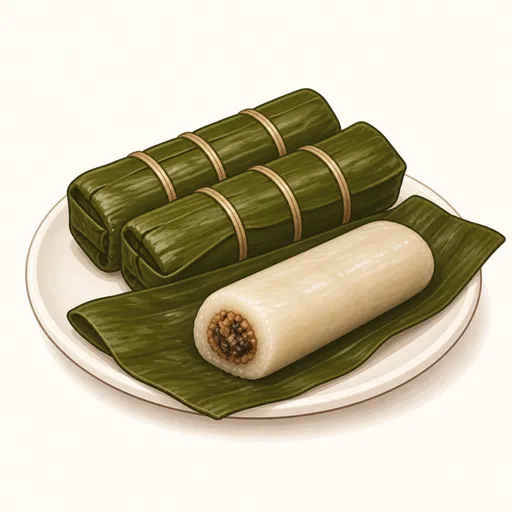
Banh te, known in some areas as banh rang bua, is a rice flour cake wrapped in dong leaves, typical of Hanoi and the provinces of the northern Red River Delta. Each cake is long and about as thick as a thumb, with a soft, silky rice flour shell around a savory filling of pork and wood ear mushrooms, and it is usually eaten hot with a little chili sauce.
- Difficulty
- Hard
- Prep
- 1 hr
- Cook
- 1 hr 50 min
- Rising or chilling
- 1 hr 30 min
- Total time
- 4 hr 20 min
- Method
- Boiled or simmered
Ingredients
Rice flour batter
Pork and wood ear filling
Dong leaves for wrapping
Instructions
Step 1
Whisk 400 g rice flour with 1,000 g water and 5 g salt in a pot until completely dissolved, then let it soak for about an hour. Rice flour that has absorbed water before cooking cooks evenly, giving a smooth shell with no grainy bits. The batter is ready when it is evenly runny and leaves no sediment on the bottom of the pot when stirred.
Step 2
Soak 15 g dried wood ear mushrooms until softened, then chop them finely. Fry 30 g minced shallots in 10 g vegetable oil, add 250 g ground pork and stir-fry over medium heat for about six minutes, then add the mushrooms and season with 10 g fish sauce and a pinch ground black pepper. Cooking the filling just until done keeps the pork juicy through the long boil. The filling is ready when the pork has firmed up, breaks into loose crumbles and smells of fried shallots.
Step 3
Add 10 g vegetable oil to the pot of batter, set it over low heat and stir constantly in one direction for about fifteen minutes until it thickens into a soft, sticky paste that is about half cooked. Steady stirring keeps the batter from lumping or scorching, and a partly cooked paste is easy to wrap and will not run out of the leaves. The paste is ready when it is thick and sticky, pulls away from the sides of the pot as you stir, and falls from the spoon in clumps.
Step 4
Wash 200 g dong leaves, wipe them dry, shave down the tough center rib and blanch them briefly in boiling water to soften. Softened leaves bend around the long cakes without tearing. The leaves are ready when they turn deep green, feel pliable and roll up easily.
Step 5
Lay out a leaf, spread a spoonful of paste into a strip about fifteen centimeters long, place a line of filling down the middle, cover with another thin layer of paste, then roll the leaf into a tube, fold in both ends and tie it in three places with string. Enclosing the filling completely in paste puts the pork right in the center when you slice the cake. The cakes are ready when they are straight, feel firm and have both ends tightly folded.
Step 6
Arrange the cakes in a pot, add water to cover them by a few centimeters and boil over medium heat for about ninety minutes, topping up with boiling water now and then. A long enough boil cooks the rice flour all the way through until it turns translucent and tender. The cakes are done when you unwrap one and the shell is clear and smooth with no cloudy white streaks, and the filling smells fragrant.
Step 7
Lift the cakes into a colander, let them drain and cool for about thirty minutes before unwrapping. Resting lets the surface firm up, so the leaves peel off cleanly and the shell does not turn mushy. They are ready when the leaves have drained and the unwrapped cakes are evenly round with a smooth, glossy surface.
Equipment
- Small saucepan
- Deep skillet
- Nonstick skillet
- Spatula
- Mixing bowl
- Whisk
- Kitchen twine
- Kitchen scale
Tips
- In Cho village in Bac Ninh, people grind their own rice flour from rice soaked overnight; you can do the same for a more fragrant, silkier cake.
- You can replace part of the water with pork bone broth to give the shell a richer, savory flavor.
- Serve banh te with sliced cinnamon pork roll or Vietnamese pork roll and chili sauce for a well-rounded meal.
Storage
Kept in their leaves, the cakes last one day at room temperature and about three days in the fridge. To serve, steam them for about ten minutes or dip them briefly in boiling water so they are soft and hot as if freshly made.
Common problems and how to fix them
- The cakes are mushy and run out of the leaves after boiling.
- The paste was not cooked thick enough before wrapping. Stir it over the heat longer until it thickens and pulls away from the sides of the pot.
- The shell still has cloudy white streaks and is undercooked.
- The cakes were not boiled long enough or the water did not cover them. Boil them for about twenty more minutes and keep the water above the cakes the whole time.
This recipe is based on the common ratios for this bake and is written entirely in our own words.