Harrow-shaped rice dumplings (banh rang bua)
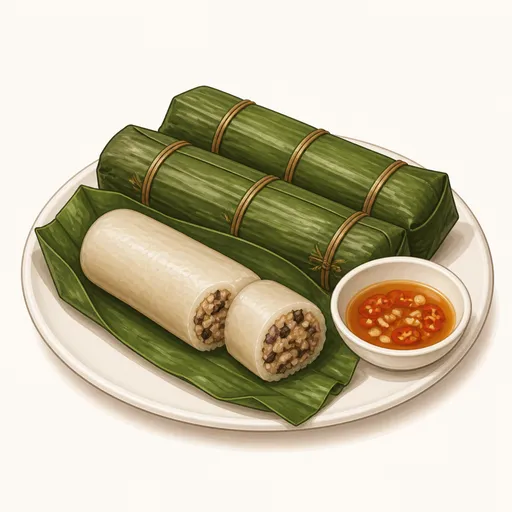
Banh rang bua is a beloved leaf-wrapped dumpling from Thanh Hoa province, named for its small, slender shape that looks like a tooth on a farmer's harrow. The wrapper is regular rice flour batter cooked halfway, wrapped around a filling of pork stir-fried with wood ear mushrooms and shallots, then folded in dong leaves and boiled. It is soft and silky, with a bold peppery flavor.
- Difficulty
- Medium
- Prep
- 1 hr
- Cook
- 50 min
- Rising or chilling
- 1 hr
- Total time
- 2 hr 50 min
- Method
- Boiled or simmered
Ingredients
Rice flour batter
Pork filling
Wrapping leaves
Instructions
Step 1
Soak 15 g dried wood ear mushrooms in warm water for about 30 minutes, trim off the tough stems and chop them finely. Softened wood ears give the filling a pleasant crunch. They are ready when they have swollen to several times their size and chop into small, even bits.
Step 2
Whisk 250 g rice flour, 25 g tapioca starch and 3 g salt with 850 g water in a saucepan until dissolved, then let it rest for about an hour. Soaking lets the flour swell evenly, so the wrapper cooks up smooth and never grainy. The batter is ready when it has dissolved completely, looks as thick as milk when stirred and no lumps settle on the bottom.
Step 3
Fry 40 g minced shallots in 15 g vegetable oil until fragrant, add 250 g ground pork and stir-fry until firm, then add the wood ears and season with 10 g fish sauce and a pinch of ground black pepper. Cooking the filling first means the dumplings need only a short boil and still taste rich. The filling is ready when the pork is dry, loose and strongly fragrant with pepper.
Step 4
Add 10 g vegetable oil to the batter, set it over low heat and stir constantly in one direction for about 15 minutes, then take it off the heat and keep stirring a few more minutes. The batter only needs to be half cooked so it stays pliable for wrapping; overcooked batter turns dry and is hard to spread on the leaves. It is ready when it is thick and heavy and falls from the ladle in thick clumps.
Step 5
Wash 200 g dong leaves, wipe them dry, trim off the stems and pass them quickly over a flame to soften. Warming over a flame makes the leaves supple, keeps them from tearing as you roll and adds fragrance during boiling. The leaves are ready when they are soft, fold without cracking and turn glossy green.
Step 6
Spoon some batter lengthwise down the middle of a leaf, scatter filling on top and cover with a thin layer of batter, then roll the leaf into a small, slender log, fold in both ends and tie it with string. Rolling it long and slim creates the harrow-tooth shape and lets the dumpling cook evenly from outside to center. The dumplings are ready when they feel firm in your hand, are about a hand span long and have no gaps at the ends.
Step 7
Arrange the dumplings in a pot, pour in boiling water to cover them and boil over medium heat for about 30 minutes. Boiling cooks the wrapper until translucent and infuses it with the scent of dong leaves. They are done when an unwrapped test dumpling has a clear, smooth wrapper that feels soft and chewy when pressed, with no opaque white batter in the middle.
Step 8
Lift the dumplings into a colander to drain, unwrap them and eat them hot with fish sauce mixed with garlic and chili or with chili sauce. While hot, the wrapper is at its softest and smoothest and the filling at its most fragrant. You will see the wrapper come away from the leaf easily and keep its neat log shape.
Equipment
- Small saucepan
- Nonstick skillet
- Mixing bowl
- Whisk
- Spatula
- Kitchen twine
- Kitchen scale
Tips
- Pork shoulder with a little fat gives a softer, richer filling than completely lean pork.
- You can add a few chopped shiitake mushrooms to the filling for extra aroma.
- When spreading the batter on the leaves, dip the spoon in cold water so the batter does not stick to it.
Storage
Left in their leaves, banh rang bua keep at room temperature for the day or in the fridge for up to three days. Before eating, steam them for about ten minutes so the wrapper turns soft and translucent again.
Common problems and how to fix them
- The wrapper is mushy and sticks firmly to the leaf.
- The batter was not cooked thick enough. Stir it longer over low heat until it feels heavy, and let it cool a little before wrapping.
- The wrapper is lumpy instead of smooth.
- The heat was too high or the stirring was not constant. Keep the heat low and stir steadily in one direction the whole time the batter cooks.
- The dumplings cook unevenly, with an opaque white center.
- The dumplings were rolled too thick or the water did not cover them. Roll them slimmer and keep them fully covered with water while boiling.
This recipe is based on the common ratios for this bake and is written entirely in our own words.