Molasses sticky rice cakes (banh mat)
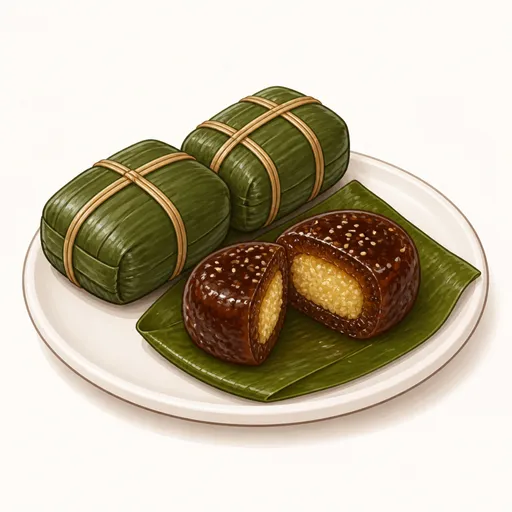
Banh mat is a rustic cake from the midlands and northern highlands of Vietnam. Its glutinous rice shell is dyed deep brown with sugarcane molasses, and inside is a nutty mung bean filling scented with toasted sesame. The shell is dense and chewy, richly sweet without being harsh, and because it is wrapped in banana leaves, it carries a faint, homey fragrance of leaf when you unwrap it.
- Difficulty
- Medium
- Prep
- 50 min
- Cook
- 45 min
- Rising or chilling
- 3 hr
- Total time
- 4 hr 35 min
- Method
- Steamed
Ingredients
Molasses glutinous rice shell
Mung bean and toasted sesame filling
Wrapping leaves and oil
Instructions
Step 1
Rinse 180 g split peeled mung beans in two changes of water, then soak them in plenty of warm water for about three hours. Beans that have absorbed enough water steam quickly and evenly and turn soft and crumbly. The beans are ready when they have swollen to nearly double in size and feel soft when pressed with a fingernail.
Step 2
Drain the beans, spread them evenly in a steamer lined with a thin cloth and steam over medium heat for about 25 minutes. Steaming cooks the beans without waterlogging them, so the filling ends up dry and easy to roll. The beans are cooked when a pinch crushes to a fine paste with a gentle squeeze, with no hard core.
Step 3
While the beans are still hot, put them in a bowl with 30 g granulated sugar and a pinch of salt and pound or mash them until smooth, then mix in 15 g white sesame seeds toasted until golden and roll the filling into balls the size of the tip of your thumb. Sugar mixed in while the beans are warm blends evenly and helps the filling hold together. The filling is ready when the balls roll without cracking and do not stick to your hands.
Step 4
Put 200 g molasses, 200 g water and a pinch of salt in a small saucepan, heat it over very low heat and stir until the molasses has fully dissolved, then let it cool a little. Thinning the molasses first lets the brown color soak evenly into the dough instead of forming streaks. The mixture is ready when it is clear, a deep amber brown and only warm to the touch of a finger.
Step 5
Pour 500 g glutinous rice flour into a large bowl, slowly add the molasses water and squeeze and knead it continuously by hand for about ten minutes. Long kneading makes the glutinous rice dough smooth and pliable, so the steamed shell does not crack. The dough is ready when it is as soft as an earlobe, an even brown and has no dry specks of flour when you rub it.
Step 6
Wipe the banana leaves clean, pass them quickly over a flame to soften, cut them into squares about 18 cm wide and brush a thin layer of vegetable oil (to taste) over the surface. Softened leaves do not tear when folded, and the oil lets the shell peel away smoothly. The leaves are ready when they turn glossy green and fold in half without splitting.
Step 7
Divide the dough into twenty portions, flatten each one, set a ball of filling in the center, then gather the edges to seal it and roll it into an oval. Wrap it in a leaf like a small rice parcel and tie it loosely with string. The shell must be sealed evenly so the filling does not ooze out as the dough softens during steaming. The wrapped cakes are ready when they feel firm in your hand and no filling shows at the edges of the leaf.
Step 8
Arrange the cakes in a steamer over boiling water, leaving a little space between them, and steam over medium heat for about 40 minutes, topping up with boiling water halfway if the pot runs low. Steady steam for long enough cooks the glutinous dough right through to the center and turns it translucent. They are done when an unwrapped test cake has a glossy, deep brown shell that feels chewy when pressed, with no opaque white left.
Step 9
Lift the cakes onto an open-weave basket and let them cool for about fifteen minutes before unwrapping and enjoying them. Resting lets the shell firm up, so the cakes cut or bite cleanly without sticking to your teeth. They are ready when the leaves are dry of steam and the shell comes away from the leaf easily.
Equipment
- Steamer
- Small saucepan
- Mixing bowl
- Kitchen scale
- Kitchen twine
- Spatula
Tips
- Molasses varies in sweetness and thickness from place to place, so taste the molasses water before mixing and use a little less if it is very strong.
- For a more distinctive flavor, add a few slices of ginger to the pot while dissolving the molasses, then remove them before mixing the dough.
- Tie the string only moderately tight, because the glutinous dough swells as it steams and string tied too tightly will pinch the cakes at the middle.
Storage
The cakes keep for two days at room temperature if left in their leaves. You can refrigerate them for up to five days; just steam them again for about ten minutes so the shell is soft and chewy as if freshly made.
Common problems and how to fix them
- The shell cracks as you wrap the cakes.
- The dough is short on water or was not kneaded long enough. Add warm water a spoonful at a time and keep kneading until the dough is soft and smooth before dividing it.
- The cakes still have an opaque white core after steaming.
- The steaming heat was too weak or the cakes were packed too closely for the steam to reach them. Space them farther apart, keep the water at a strong boil and steam ten minutes longer.
This recipe is based on the common ratios for this bake and is written entirely in our own words.