Hue-style crispy pancakes (banh khoai)
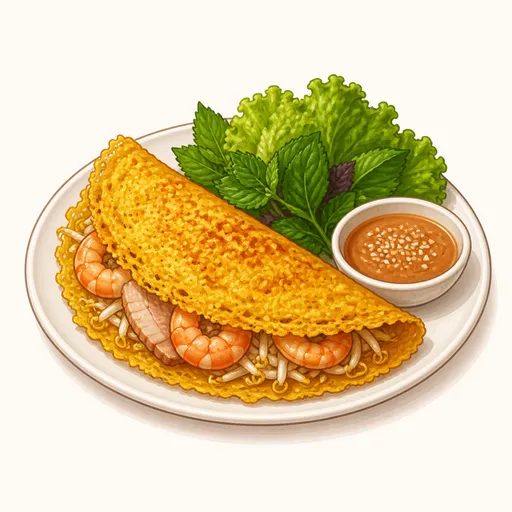
Banh khoai is the signature crispy pancake of Hue, thicker and crunchier than southern banh xeo because it is fried in a small pan with plenty of oil. The turmeric-yellow shell wraps around shrimp, pork belly and bean sprouts, and it is served with fresh herbs and a bowl of thick dipping sauce made from liver, peanuts and sesame, a rich, nutty flavor you will not forget.
- Difficulty
- Medium
- Prep
- 45 min
- Cook
- 40 min
- Rising or chilling
- 30 min
- Total time
- 1 hr 55 min
- Method
- Fried
Ingredients
Batter
Filling and frying oil
Peanut and liver dipping sauce
Fresh herbs on the side
Instructions
Step 1
Beat 100 g eggs and put them in a bowl with 200 g rice flour, 2 g ground turmeric, a pinch of salt and 380 g water. Stir well, let it rest for thirty minutes, then mix in 20 g finely sliced scallions just before frying. Resting lets the rice flour absorb the water, so the shell turns crisp instead of crumbly. The batter is ready when it is thin and smooth like milk, an even turmeric yellow and has no sediment settling.
Step 2
Boil 200 g pork belly over medium heat for about fifteen minutes, then slice it very thinly. Peel 200 g fresh shrimp, split them in half along the back and season them with a pinch of ground black pepper. Boiling the pork first cooks it fully tender, while the shrimp only need a quick sear as you fry the pancakes. The filling is ready when the pork slices are evenly thin with a translucent rim of fat and the shrimp are cleaned of their dark veins.
Step 3
Blend 40 g roasted peanuts and 10 g white sesame seeds with 150 g water until smooth. Sauté 5 g garlic and 10 g shallots in 10 g vegetable oil until fragrant, then add the blended mixture along with 40 g liver pate, 30 g soy sauce, 10 g granulated sugar and 10 g rice flour and simmer over low heat for about eight minutes. The rice flour thickens the sauce, while the liver and peanuts give it the rich, nutty taste typical of Hue. The sauce is ready when it is as thick as thinned condensed milk, light brown and smells of roasted peanuts.
Step 4
Set a small pan about eighteen centimeters wide over high heat and add about two tablespoons of the vegetable oil (to taste). When the oil is very hot, add a few slices of pork and a few shrimp and sear them. Very hot oil firms up the filling right away and makes the batter puff and crisp the moment it hits the pan. The filling is ready when the shrimp just turn pinkish orange and the pork fat starts to sizzle.
Step 5
Stir the batter again, ladle just enough over the filling to coat the bottom of the pan and tilt the pan to spread it evenly. Scatter a small handful of bean sprouts (from the 150 g) over one half, then cover for about two minutes. Covering traps the heat so the bean sprouts cook through and the top sets while the bottom crisps up. The pancake is ready when the top of the batter is no longer wet and a golden, crisp rim appears around the edge of the pan.
Step 6
Uncover, drizzle a little more oil around the edge, lower the heat to medium and fry for about three more minutes, then fold the pancake in half and turn it gently so both sides crisp. Frying uncovered lets all the steam escape, so the shell turns dry and crunchy. It is ready when the shell is deep golden, sounds crisp when tapped and feels sturdy when lifted.
Step 7
Rest the pancake on paper towels for a moment, then arrange it on a plate with 100 g mixed fresh herbs, dip it generously into the sauce and eat it piping hot. The paper towels soak up extra oil so the pancake stays crisp longer and does not feel greasy. It is ready when it stays crisp on the plate and no oil is pooling on it.
Equipment
- Nonstick skillet
- Small saucepan
- Mixing bowl
- Whisk
- Spatula
- Blender
- Kitchen scale
Tips
- In Hue, banh khoai is often eaten with sliced sour star fruit and green banana; add them to the herb plate to balance the richness.
- A small cast-iron pan holds heat best for this dish; if you use a nonstick pan, heat it thoroughly before adding the oil.
- If you have fermented soybean paste, replace half the soy sauce with mashed soybean paste for a more traditional, deeper-tasting sauce.
Storage
Banh khoai is best eaten right after frying. The mixed batter can be covered and kept in the fridge for one day; stir it again before using. Cooled dipping sauce keeps in a sealed jar in the fridge for two days; reheat it and add a little water if it is too thick.
Common problems and how to fix them
- The shell is soft and limp instead of crisp.
- The pan or oil was not hot enough, or the batter was poured too thick. Wait until the oil is very hot before adding the batter, and use only enough to coat the bottom of the pan thinly.
- The pancake sticks to the pan and breaks when folded.
- The bottom did not have time to form a crisp layer before folding. Fry one to two minutes longer after uncovering and drizzle a little more oil around the edge.
This recipe is based on the common ratios for this bake and is written entirely in our own words.