Glutinous rice dumplings with savory filling (banh it tran)
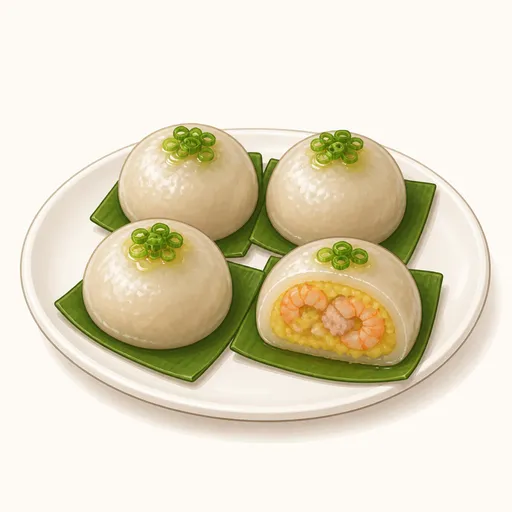
Banh it tran are snow-white glutinous rice dumplings that are not wrapped in leaves; each one simply sits on a small square of banana leaf while it steams. The shell is soft, chewy and slightly translucent, and inside is a savory filling of mung beans mixed with shrimp and pork. Serve them with scallion oil and sweet and tangy fish sauce for the true taste of central Vietnam.
- Difficulty
- Medium
- Prep
- 1 hr
- Cook
- 40 min
- Rising or chilling
- 2 hr
- Total time
- 3 hr 40 min
- Method
- Steamed
Ingredients
Glutinous rice shell
Shrimp, pork and mung bean filling
Scallion oil topping
Banana leaf liners
Instructions
Step 1
Soak 120 g split peeled mung beans in warm water for about two hours, then rinse away any loose skins. Well-soaked beans cook evenly and mash more smoothly, which keeps the filling from being dry. The beans are ready when they are plump and crumble when rubbed between two fingers.
Step 2
Put the drained beans in a steamer and steam for about twenty minutes, then mash them very finely with a spoon while they are still hot. Mashing them hot makes them smooth quickly and easier to mix with the shrimp and pork later. The beans are ready when no whole beans remain and they form a soft, crumbly mass.
Step 3
Peel 150 g fresh shrimp and chop them finely. Fry 20 g shallots until fragrant, add the shrimp and 150 g ground pork and stir-fry over medium heat, seasoning with 10 g fish sauce, 5 g granulated sugar and a pinch of ground black pepper, and finally mix in the beans. Cook the filling until dry so no liquid seeps out during steaming and turns the shell mushy. The filling is ready when the shrimp are pink and cooked through, the mixture has firmed up and you can press it into balls.
Step 4
Dissolve a pinch of salt in 210 g warm water, pour it slowly into 300 g glutinous rice flour and knead evenly, then add 10 g vegetable oil and knead a few more minutes. Adding the water a little at a time lets you control how soft the dough gets, since every brand of glutinous rice flour absorbs water differently. The dough is ready when it is as smooth as clay, does not stick to your hands and the edges do not crack when you flatten it.
Step 5
Divide the filling into twenty small balls and the dough into twenty portions. Flatten each portion of dough, set a ball of filling in the center, smooth the edges closed and roll it into a ball, then place each one on a piece of oiled 100 g banana leaf. The oiled leaf keeps the dumplings from sticking to the steamer and gives them a neat round base. They are ready when they are perfectly round, the shell is evenly thick and no filling shows through.
Step 6
Arrange the dumplings in the steamer slightly apart and steam over high heat for about fifteen minutes once the water is at a rolling boil. Strong steam cooks the glutinous shell quickly and makes it translucent without slumping. They are done when the shell has turned from opaque white to slightly translucent and feels chewy and springy to the touch.
Step 7
Finely chop 40 g scallions. Heat 40 g vegetable oil over low heat until very hot, then pour it over the scallions and stir quickly. Oil that is just hot enough brings out the scallion aroma while keeping the bright green color. The scallion oil is ready when the scallions are soft and glossy green and their fragrance fills the air.
Step 8
Transfer the dumplings to a plate while still warm, spoon some scallion oil over each one and serve with sweet and tangy dipping fish sauce. They taste best warm, when the shell is still soft and chewy and soaks up the scallion oil. They are ready when the tops glisten with scallion oil and the shells no longer stick when you pick them up.
Equipment
- Steamer
- Nonstick skillet
- Mixing bowl
- Kitchen scale
- Small saucepan
Tips
- If the dough cracks as you shape it, dip your hands in water and knead the dough a little more so it turns moist and pliable again.
- You can sprinkle a little shrimp floss or crushed crispy pork cracklings over the dumplings for extra crunch and richness.
- Rubbing a thin layer of oil on your hands while rolling keeps the dough from sticking and gives the dumplings a lovely sheen after steaming.
Storage
Banh it tran are best the day they are made. If you have leftovers, keep them in an airtight container in the fridge for up to two days, and steam them again for about five minutes before eating so the shell turns soft and chewy again.
Common problems and how to fix them
- The dumplings slump flat and stick together in the steamer.
- The dough was too soft or the dumplings were packed too closely. Use less water when kneading and leave about a fingertip's width of space between them.
- The shell is hard with an opaque white core after steaming.
- The shell was too thick or the dumplings were not steamed long enough. Make the shell thinner and steam a few minutes longer until the whole shell turns translucent.
This recipe is based on the common ratios for this bake and is written entirely in our own words.