Ramie leaf sticky rice dumplings (banh it la gai)
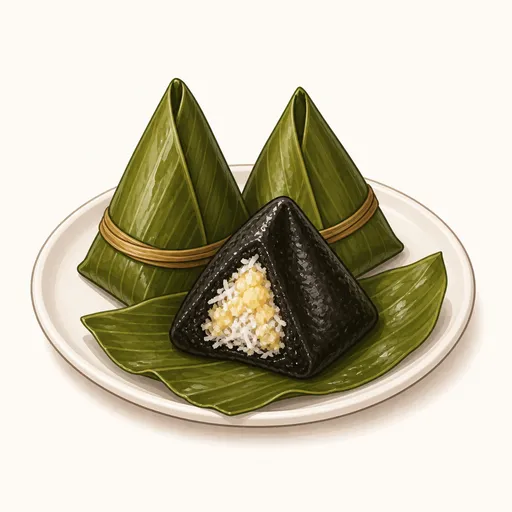
Banh it la gai is a specialty of Binh Dinh province: a glossy black shell of glutinous rice flour blended with ramie leaves, wrapped around a sweet, nutty mung bean and coconut filling and folded into pointed banana leaf pyramids. The dumplings are soft and chewy with the fresh, gentle scent of ramie leaves, and they often appear at memorial feasts and weddings or travel as gifts for loved ones far away.
- Difficulty
- Hard
- Prep
- 1 hr 40 min
- Cook
- 50 min
- Rising or chilling
- 3 hr
- Total time
- 5 hr 30 min
- Method
- Steamed
Ingredients
Ramie leaf shell
Mung bean and coconut filling
Wrapping leaves
Instructions
Step 1
Rinse 200 g split peeled mung beans very well, then soak them for about three hours, rinsing a few times to wash away any skins, and drain. Well-soaked beans make a smooth, bright yellow filling. The beans are ready when they are soft and no green skins are mixed in.
Step 2
Wash 150 g ramie leaves, drop them into a pot of boiling water and cook over medium heat for about 20 minutes, then lift them out, rinse under cold water and squeeze them as dry as you can. Thorough boiling softens the fibers in the leaves and tames their astringency. The leaves are ready when they have turned dark blackish green, are completely limp and release no more water when squeezed.
Step 3
Put the ramie leaves in a blender with 200 g granulated sugar and 60 g water and blend for a long time into a smooth, thick paste. The sugar helps the leaves break down faster and later gives the shell its sheen. The paste is ready when it is as smooth as jam, glossy black and free of leaf fibers.
Step 4
Gradually work the ramie paste into 500 g glutinous rice flour and knead continuously for about 20 minutes, rubbing a little oil on your hands if the dough sticks. Long kneading binds the ramie and rice flour tightly together for a soft, chewy shell. The dough is ready when it is an even glossy black, soft and smooth and no longer sticks to your hands.
Step 5
Steam the mung beans for about 25 minutes until crumbly and tender, then blend or mash them very finely. A smooth bean paste blends well with the sugar and coconut as it cooks down. The beans are ready when the paste is smooth with no gritty bits.
Step 6
Put the beans in a nonstick pan with 120 g granulated sugar and 100 g freshly grated coconut and cook them down over low heat, stirring constantly. Cooking the filling dry enough helps it hold its shape and keeps it from wetting the shell. The filling is ready when it gathers into a mass, no longer sticks to the pan and can be rolled into a ball without cracking.
Step 7
Divide the filling into balls the size of a small lime and the dough into portions one and a half times the size of the filling. Flatten a portion of dough in an oiled palm, set a ball of filling in the center, smooth the dough closed and shape it into a pyramid. The shell must cover the filling evenly so it does not peek through during steaming. The shaped dumplings are ready when they have a round base and a pointed tip with no filling showing.
Step 8
Wipe clean 250 g banana leaves that have been softened over a flame, brush them with a thin layer of vegetable oil (to taste), roll a leaf into a pointed cone, set a dumpling inside and fold the rest of the leaf over to cover the base. The oiled leaf keeps the dumplings from sticking when you unwrap them, and the pointed cone creates their signature pyramid shape. The wrapped dumplings are ready when the tips are neat and pointed and the bases are flat enough to stand steadily.
Step 9
Stand the dumplings upright in the steamer with a little space between them and steam over high heat for about 40 minutes, checking halfway and topping up the pot with boiling water. Strong, steady heat cooks the shell until translucent and chewy. They are done when an unwrapped test dumpling has a glossy black shell that springs back when pressed, with no white core of raw dough.
Step 10
Take the dumplings out and let them cool for about 30 minutes in an airy basket before unwrapping. As they cool, the shell firms up and no longer sticks to the leaf. They are ready when they keep their pyramid shape after unwrapping and the shell is smooth and glossy.
Equipment
- Steamer
- Blender
- Small saucepan
- Nonstick skillet
- Mixing bowl
- Kitchen scale
Tips
- To save time, you can buy ready-ground ramie leaf paste at the market; in that case, use less water because the paste is already moist.
- A little vanilla or a few drops of pomelo blossom essence in the filling makes the dumplings even more fragrant.
- Choose lady finger banana leaves and soften them over a flame or dip them in boiling water so they do not tear when you roll the cones.
Storage
Banh it la gai keep at room temperature for two to three days when left in their leaves. You can refrigerate them for up to a week; steam them again for about ten minutes before eating so the shell turns soft and chewy again.
Common problems and how to fix them
- The shell slumps and does not hold its pyramid shape.
- The dough was too wet because the leaves were not squeezed dry enough. Knead in more glutinous rice flour a little at a time until the dough no longer sticks to your hands.
- The shell turns hard and cracks after a day.
- The dough had too little sugar or was not kneaded long enough. Steam the dumplings again, and next time knead the dough more thoroughly until smooth and pliable.
- The filling turns sour after sitting overnight.
- The filling was not cooked down enough. Cook it until it gathers into a mass and no more steam rises from it.
This recipe is based on the common ratios for this bake and is written entirely in our own words.