Pressed sweet rice flour cakes (banh in)
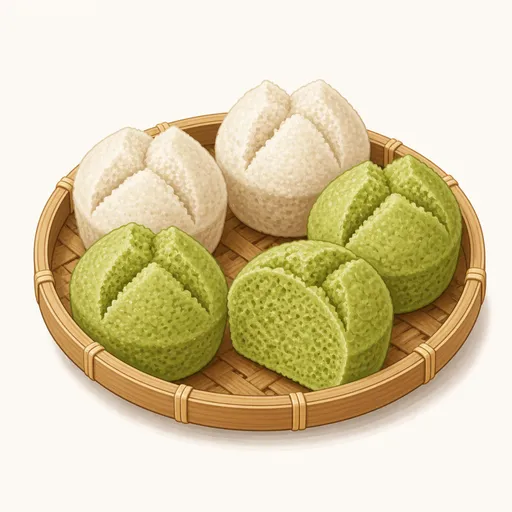
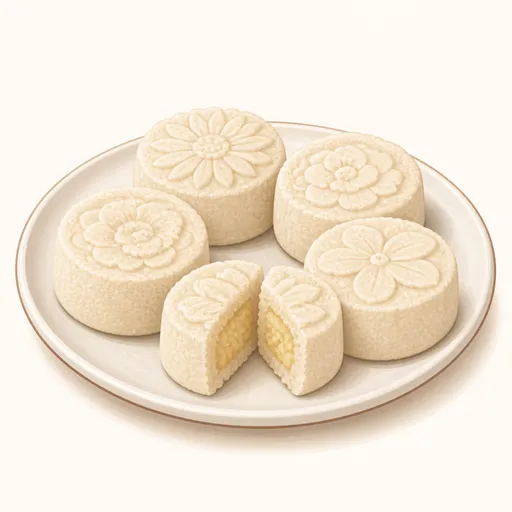
Banh in are dainty little cakes that appear on Lunar New Year feast tables and offering trays, and they are most famous in Hue. They are pressed firmly from roasted glutinous rice flour and sugar, and they slowly melt in your mouth with the sweet fragrance of coconut milk and a nutty mung bean filling.
- Difficulty
- Easy
- Prep
- 1 hr
- Cook
- 30 min
- Rising or chilling
- 6 hr
- Total time
- 7 hr 30 min
- Method
- No cooking
Ingredients
Cake dough
Mung bean filling
Flour for dusting the mold
Instructions
Step 1
Put 100 g split peeled mung beans in a bowl, rinse until the water runs clear, then soak them for about three hours until soft. Well-soaked beans steam through without a hard core in the middle. The beans are ready when a broken bean is an even yellow from the outside to the center.
Step 2
Spread the drained beans in a steamer lined with a thin cloth and steam for about 25 minutes. The cloth keeps the beans from falling into the pot and spreads the steam evenly. The beans are cooked when a pinch crumbles into a fine powder with a gentle squeeze.
Step 3
Mash the cooked beans until smooth, put them in a pan with 70 g granulated sugar and 15 g vegetable oil and cook them down over low heat, stirring steadily. The filling for banh in needs to be drier than for other cakes so it does not moisten the pressed shell. The filling is ready when it is dry, fine and crumbly and can be rolled into balls without sticking to your hands.
Step 4
Let the filling cool, then roll it into about twenty small balls the size of the tip of your thumb. Small balls leave enough dough around them so the cakes do not break when they come out of the mold. The balls are ready when they are round, firm and about the same size.
Step 5
Mix 140 g powdered sugar with 70 g coconut milk and 1 g pomelo blossom essence, stirring until it forms a thick paste. Moistening the sugar first helps it spread evenly through the roasted flour. The mixture is ready when it is as smooth as thick cream with no dry lumps of sugar left.
Step 6
Pour the sugar mixture into 200 g roasted glutinous rice flour, rub it between your palms until evenly crumbly, then cover tightly and let it rest for about 30 minutes. Rubbing instead of kneading moistens the flour evenly while keeping it crumbly, which is exactly the texture banh in needs. The dough is ready when a squeezed handful holds its shape but breaks apart with a gentle press.
Step 7
Dust the mold with roasted glutinous rice flour (to taste), fill it about halfway with dough, set a ball of filling on top, add more dough to fill it up, then press very firmly with your fingers and level the top. Tap the mold gently so the cake drops out. Pressing firmly is the key step that keeps the cakes from crumbling. They are ready when they come out whole, with a crisp pattern and a flat bottom.
Step 8
Arrange the cakes on an airy tray and leave them in a dry place for about three hours so the surface firms up before you box them. Dry air hardens the outside slightly, so the cakes keep their pattern when moved. They are ready when they hold their shape as you pick them up and the surface feels dry and smooth.
Equipment
- Shaping molds
- Steamer
- Nonstick skillet
- Sieve
- Mixing bowl
- Spatula
- Plastic wrap
- Kitchen scale
Tips
- Store-bought roasted glutinous rice flour is very convenient, but if you roast your own, toast the glutinous rice over low heat until the grains puff and turn white, then grind it finely and sift well.
- You can skip the filling to make solid banh in; in that case, press very firmly and add a little more coconut milk so the cakes hold together better.
- Wooden molds need dusting with flour before each pressing, while plastic molds only need to be wiped dry.
Storage
Banh in are quite dry, so they keep for about a week in an airtight container in a cool, airy place. Keep them away from damp spots, because they absorb moisture and turn soft and mushy.
Common problems and how to fix them
- The cakes are crumbly and break when you take them out of the mold.
- The dough was too dry or was not pressed firmly enough. Sprinkle in a few spoonfuls of coconut milk, rub it in evenly and press harder.
- The cakes stick to the mold and lose their pattern.
- The dough was too moist or the mold was not dusted. Let the dough rest a little longer to dry out and dust the mold with a thin layer of roasted flour before each pressing.
This recipe is based on the common ratios for this bake and is written entirely in our own words.