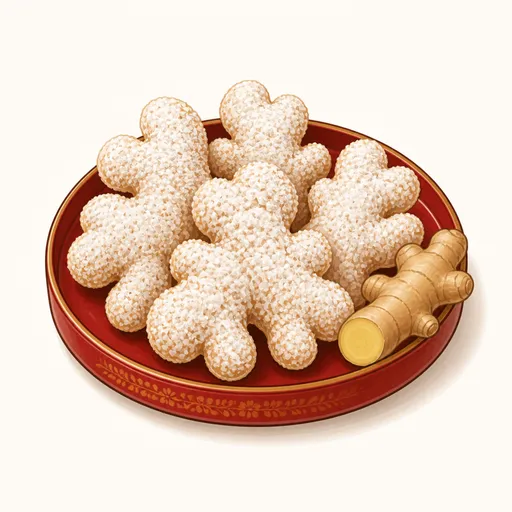
Ginger-shaped sugar-glazed crisps (banh gung)
Banh gung is a traditional Lunar New Year treat shaped like knobs of ginger root. Glutinous rice dough is shaped, fried until puffed and then coated in a fine white sugar crust infused with the warm bite of ginger. Each piece is light and crisp, gently sweet and fragrant, and it usually sits on the festive candy tray next to a pot of hot tea.
- Difficulty
- Medium
- Prep
- 50 min
- Cook
- 40 min
- Rising or chilling
- 50 min
- Total time
- 2 hr 20 min
- Method
- Fried
Ingredients
Dough
Frying oil
Ginger sugar coating
Instructions
Step 1
Put 300 g glutinous rice flour and a pinch of salt in a bowl, crack 50 g eggs into the center, add 20 g melted lard, then slowly pour in 150 g warm water while you knead. The eggs and lard make the crisps light and rich, while the warm water helps the glutinous rice flour turn pliable quickly. The dough is ready when it is as soft as an earlobe, smooth and glossy and comes cleanly away from the sides of the bowl.
Step 2
Cover the bowl with plastic wrap and let the dough rest for about 20 minutes in a cool, airy spot. Rested dough is more pliable and elastic, so the little knobs do not break off as you shape them. You know it has rested enough when a fingertip dent slowly fills back in.
Step 3
Divide the dough into pieces the size of a quail egg, shape each into a flat body about four centimeters long, then pull out two or three small knobs on the sides so it looks like a ginger root, and prick a few small holes in the top with a toothpick. The holes let steam escape during frying so the crisps do not burst. They are shaped when the knobs are firmly attached to the body and the thickness is even.
Step 4
Put the crisps into still-warm oil (to taste), about 120°C, and fry over low heat for 10 to 12 minutes, turning them gently now and then. Starting in warm oil lets them puff up slowly and turn hollow inside, like little pillows. This step is done when they have nearly doubled in size, float to the surface and are still ivory white.
Step 5
Raise the heat to medium and fry a few more minutes until the shells are dry and firm, then lift them onto a rack lined with paper towels and let them cool completely. This hotter round of frying helps the shells keep their puffed shape as they cool instead of collapsing. They are ready when they are evenly pale golden, sound hollow when tapped and no oil is pooling on them.
Step 6
Pound 20 g fresh ginger with 80 g water until fine, then strain out the juice. Pour it into a wide pan with 250 g granulated sugar and cook over medium heat without stirring. The ginger juice gives the sugar coating its signature warm, spicy kick. The syrup is ready when it bubbles with fine little bubbles and a chopstick dipped in and lifted out pulls a thin thread.
Step 7
Turn off the heat, tip the crisps into the pan of syrup and toss them constantly with long chopsticks until the sugar coats every knob. As you keep tossing while it cools, the sugar crystallizes into a white coating that looks like frost. They are ready when the surface is smooth and white, drying gradually, and the pieces separate from each other.
Step 8
Spread the crisps out on a tray, separate any that are stuck together and leave them in a dry, airy place for about 30 minutes. The sugar coating needs time to set and harden. They are finished when the coating feels dry, is not sticky and snaps crisply when you break a piece.
Equipment
- Deep skillet
- Small saucepan
- Mixing bowl
- Spatula
- Thermometer
- Kitchen scale
- Wire cooling rack
Tips
- Shape the crisps on a tray dusted with a little dry glutinous rice flour so they do not stick to it before frying.
- If you like a stronger ginger flavor, you can knead a little pounded ginger into the dough, but not too much, or the crisps will not puff well.
- Fry moderate batches that cover only about half the surface of the oil, because the crisps puff up a lot and need room to roll around evenly.
Storage
Store banh gung in a tightly sealed tin or glass jar in a dry place, and they will stay crisp for about three weeks. In humid weather, add a packet of desiccant to the container so the sugar coating does not turn sticky.
Common problems and how to fix them
- The crisps do not puff and are dense and hard inside.
- The dough was too dry or the oil was too hot from the start. Knead in more water until the dough is as soft as an earlobe, and always start frying while the oil is only warm.
- The sugar coating is patchy, covering some spots and missing others.
- The sugar crystallized before you added the crisps. Keep the crisps ready beside the stove, tip them in the moment you turn off the heat and toss them quickly.
- The crisps collapse after you take them out.
- The shells were not dry and firm enough. Fry them a few more minutes over medium heat until they sound hollow when tapped before lifting them out.
This recipe is based on the common ratios for this bake and is written entirely in our own words.