Pyramid rice dumplings with pork (banh gio)
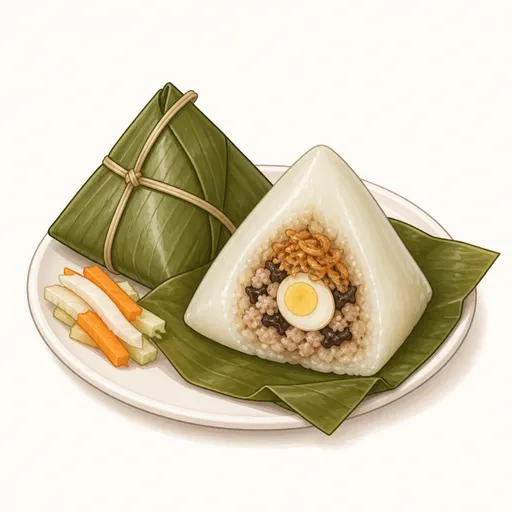
Banh gio is a beloved breakfast in northern Vietnam: pyramid-shaped dumplings wrapped in green banana leaves. The wrapper is rice flour cooked in liquid until soft, silky and smooth, and inside hides a filling of ground pork, wood ear mushrooms and fragrant fried shallots. Enjoy them hot with Vietnamese pork roll, quick pickles or chili sauce.
- Difficulty
- Medium
- Prep
- 50 min
- Cook
- 40 min
- Rising or chilling
- 30 min
- Total time
- 2 hr
- Method
- Steamed
Ingredients
Batter
Pork and mushroom filling
Wrapping leaves
Instructions
Step 1
Put 250 g rice flour, 40 g tapioca starch and 4 g salt in a large pot, pour in 1,000 g water, stir until dissolved and let it rest for about 30 minutes. Soaking lets the starch absorb water evenly, so the cooked wrapper turns out smoother and more translucent. The batter is ready when the flour has settled lightly to the bottom and the water on top looks slightly clear.
Step 2
Soak 15 g dried wood ear mushrooms until soft, then chop them finely. Fry 30 g minced shallots in 15 g vegetable oil, then add 300 g ground pork and stir-fry it with the mushrooms, 15 g fish sauce and a pinch of ground black pepper for about 10 minutes. If you are using 100 g quail eggs, boil and peel them. A filling that is just cooked and still a little moist stays tender and juicy as it steams with the batter. The filling is ready when the pork has turned white, crumbled evenly and smells of fried shallots.
Step 3
Wash 400 g banana leaves, blanch them in boiling water, wipe them dry and cut them into pieces about thirty centimeters long; each dumpling needs two pieces laid crosswise. Blanched leaves are soft enough to roll into a cone without tearing. The leaves are ready when they are supple, glossy green and fold without cracking.
Step 4
Stir the pot of batter well again, add 15 g vegetable oil, set it over medium heat and stir constantly in one direction for about 12 minutes, until the batter is thick and about seventy percent cooked. Constant stirring keeps the batter from catching on the bottom and from turning lumpy. The batter is ready when it is as thick as paste, falls slowly from the spoon and starts to look translucent white.
Step 5
Roll two pieces of leaf into a cone, spoon a layer of batter into the bottom, add a spoonful of filling and a quail egg in the center, cover with more batter, then fold the top of the leaves into a pyramid and tie it with twine. Sealing the filling in batter keeps the meat juices from leaking out during steaming. The dumplings are ready when they have an even pyramid shape, feel firm in your hand and the leaves have no gaps at the edges.
Step 6
Stand the dumplings upright in the steamer, cover tightly and steam over high heat for about 25 minutes. The strong steam fully cooks the raw part of the batter and binds it with the filling. They are done when an opened dumpling has a translucent, soft wrapper that springs back when pressed lightly, with no opaque white core left.
Step 7
Take the dumplings out, let them cool for about five minutes, then unwrap them onto a plate and serve with Vietnamese pork roll, quick pickles or chili sauce as you like. A few minutes of rest lets the wrapper firm up, so the leaves peel off easily without sticking. They are just right when they keep their pyramid shape after unwrapping and the surface is smooth and glossy.
Equipment
- Steamer
- Small saucepan
- Nonstick skillet
- Whisk
- Spatula
- Mixing bowl
- Kitchen scale
- Kitchen twine
Tips
- You can replace half of the water with pork bone broth for a more savory wrapper.
- If the batter starts to turn lumpy while cooking, take the pot off the heat, whisk hard until smooth, then keep cooking.
- Wrap the dumplings while the batter is still hot, because cooled batter thickens and is hard to spread evenly in the leaves.
Storage
Banh gio keeps at room temperature for one day. You can also keep them in their leaves in the fridge for up to three days or in the freezer for up to a month; steam them again for about ten minutes before eating, and they will be soft and hot as if freshly made.
Common problems and how to fix them
- The wrapper is crumbly and cracks when you unwrap the leaves.
- The batter was cooked too thick before wrapping. Stop cooking as soon as it reaches a paste-like consistency and wrap right away while it is still hot.
- The dumplings are mushy and do not hold their shape.
- The batter was not cooked long enough or had too much water. Stir it on the stove for a few more minutes until it is thick before wrapping.
This recipe is based on the common ratios for this bake and is written entirely in our own words.