Pounded sticky rice cakes (banh giay)
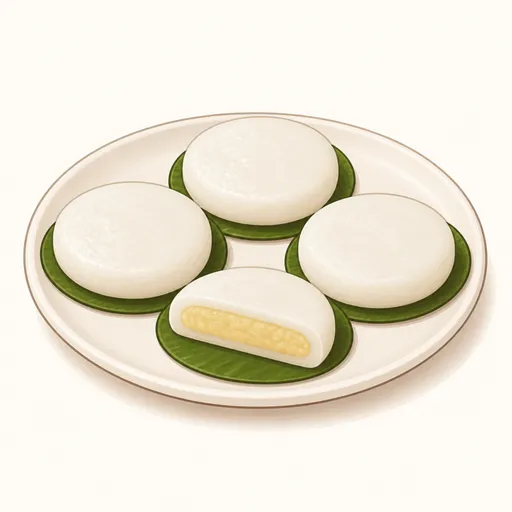
Banh giay are snow-white, round, flat glutinous rice cakes tied to the legend of Prince Lang Lieu, and they often appear on Lunar New Year tables and at village festivals. This version uses glutinous rice flour that is steamed and then kneaded while hot, giving a smooth, chewy shell that encloses a sweet, nutty mung bean and coconut filling, with each cake set on a piece of banana leaf so it doesn't stick.
- Difficulty
- Medium
- Prep
- 45 min
- Cook
- 40 min
- Rising or chilling
- 2 hr
- Total time
- 3 hr 25 min
- Method
- Steamed
Ingredients
Glutinous rice shell
Mung bean and coconut filling
Leaves and oil to prevent sticking
Instructions
Step 1
Rinse 150 g split peeled mung beans, then soak them in warm water for about two hours. Beans that have absorbed enough water cook quickly and mash more smoothly. They are ready when they have nearly doubled in size and break apart when pinched gently between two fingers.
Step 2
Drain the beans, spread them evenly in a steamer basket and steam over medium heat for about 25 minutes. Steaming rather than boiling keeps the beans dry, so the filling doesn't turn mushy. They are done when they are soft and crumbly and no longer firm in the center when you taste one.
Step 3
While the beans are still hot, mash them smoothly, then mix in 60 g granulated sugar, 50 g freshly grated coconut and a pinch of salt and stir in a nonstick pan over low heat for a few minutes. Gentle cooking dissolves the sugar and dries the filling enough to roll into balls. The filling is ready when it gathers into a mass, doesn't stick to your hands and rolls into neat balls.
Step 4
Wipe 80 g banana leaves clean, pass them quickly over a flame to soften, then cut them into squares about 8 cm on each side and brush them with a thin layer of oil. Wilted leaves are supple and won't tear when you press the cakes onto them, while the oil keeps the glutinous rice shell from sticking. The leaves are ready when they turn a glossy deep green and fold without cracking.
Step 5
Put 300 g glutinous rice flour and a pinch of salt in a bowl, slowly pour in 250 g warm water and knead until the dough comes together, then press it into a layer about two finger joints thick on an oiled plate. Kneading first lets the glutinous rice flour absorb water evenly, so no raw core remains after steaming. The dough is ready when it is as soft as an earlobe and doesn't stick to your hands.
Step 6
Set the plate of dough in a steamer over rapidly boiling water and steam over high heat for about 15 minutes. Strong steam cooks the glutinous rice starch until translucent and chewy. The dough is cooked when it turns from opaque white to more translucent and a chopstick pushed into the center finds no raw white dough.
Step 7
Tip the hot glutinous rice dough into a bowl greased with 10 g vegetable oil and, using a pestle or flat spatula dipped in cold water, press and pound it vigorously and continuously for about five minutes. Pounding the dough while hot mimics the traditional way of making banh giay, giving the shell its smooth, chewy texture. The dough is ready when it is glossy and silky, stretches into pliable strands and has no lumps.
Step 8
Oil your hands, divide the dough into twelve pieces, flatten each one, place a ball of filling in the middle, then pinch the edges closed and press it into a flat round on a piece of banana leaf. Shaping while the dough is still warm makes the edges seal tightly. The cakes are ready when they are evenly round with a smooth, flat top and no filling showing.
Step 9
Place another piece of leaf on top of each cake and let them cool for about fifteen minutes before arranging them on a plate. This short rest lets the shell firm up so the cakes keep their shape when picked up. They are ready when the shell is soft and chewy and the leaf peels off easily, leaving the surface of the cake intact.
Equipment
- Steamer
- Small saucepan
- Mixing bowl
- Kitchen scale
- Spatula
- Plastic wrap
Tips
- Dip the pestle or spatula in cold water every few strokes so the dough doesn't stick and your arms don't tire as quickly.
- For the northern style, you can leave out the filling and sandwich the plain banh giay with a slice of Vietnamese pork sausage.
- Slightly dry banana leaves tear easily, so pass them very quickly over a flame or dip them in hot water for a few seconds before cutting.
Storage
Banh giay are best on the day they are made, kept covered at room temperature. To keep them longer, wrap each cake individually and refrigerate for up to two days, then steam them for about three minutes before eating so the shell turns soft and chewy again.
Common problems and how to fix them
- The shell turns hard after a few hours.
- The glutinous rice dried out after being left uncovered. Always keep the cakes covered with leaves or plastic wrap, and steam them briefly before eating if they have hardened.
- The shell has a hard, white, undercooked core.
- The layer of dough was too thick or wasn't steamed long enough. Spread the dough thinner on the plate and steam for five minutes more until it is evenly translucent.
This recipe is based on the common ratios for this bake and is written entirely in our own words.