Nodding egg sponge cakes (banh gat gu)
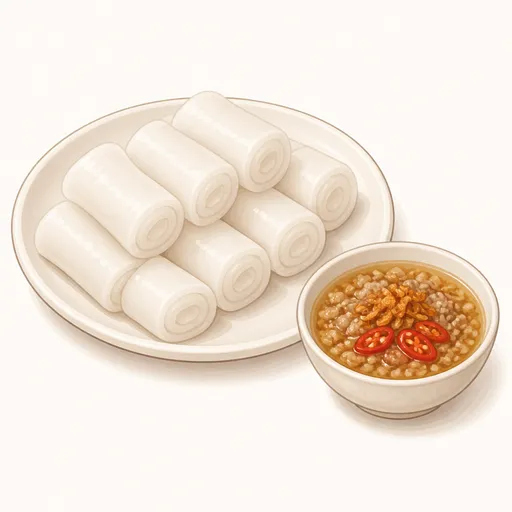
Banh gat gu are a specialty of Tien Yen in Quang Ninh province, steamed from long-grain rice flour blended with day-old cooked rice, which makes them thicker, softer and chewier than banh cuon. The sheets are rolled up, cut into lengths and dipped in a rich, fragrant ground pork sauce made with chicken fat, so delicious that everyone who eats them nods in approval.
- Difficulty
- Medium
- Prep
- 30 min
- Cook
- 50 min
- Rising or chilling
- 30 min
- Total time
- 1 hr 50 min
- Method
- Steamed
Ingredients
Batter
Oil for greasing
Ground pork and chicken fat dipping sauce
Instructions
Step 1
Put 100 g day-old cooked rice in a blender with 450 g water, blend until very smooth, then pour it into a bowl with 250 g rice flour, 25 g tapioca starch and a pinch of salt and stir until evenly dissolved. The cooked rice is the secret behind the signature soft, chewy texture of banh gat gu. The batter is ready when it is as smooth as thinned condensed milk with no grains of rice left.
Step 2
Cover the bowl and let the batter rest for about 30 minutes at room temperature, then stir it again before using. Resting lets the starch absorb the water evenly, so the steamed sheets are smooth and free of pits. The batter is ready when its surface is flat and it looks uniform when stirred, with no sediment at the bottom.
Step 3
Fill a pot with water, stretch a thin cloth very tightly over the mouth of the pot, leaving a small gap at the edge for steam to escape, then bring the water to a rolling boil over high heat and brush the cloth with a little oil (to taste). A flat, taut cloth and even heat are what give evenly thick sheets without holes. The pot is ready when steam rises evenly through the cloth and it feels slightly damp to the touch.
Step 4
Pour a full ladle of batter onto the cloth and swirl the bottom of the ladle to spread it into a layer slightly thicker than banh cuon, then cover and steam for about two to three minutes. A thicker layer gives the sheets the chewy softness of authentic banh gat gu. The sheet is cooked when it puffs slightly, turns translucent and shows small bubbles.
Step 5
Slide a flat bamboo stick under the edge of the sheet to lift it onto an oiled tray, roll it up while still hot and cut it into lengths of about fifteen centimeters. Rolling while hot helps the layers stick together and hold their shape. You have done it right when the rolls are tight and round, the surface is glossy and smooth and nothing has torn.
Step 6
Melt 40 g chicken fat in a small saucepan, add 30 g thinly sliced shallots and fry over medium heat, stirring steadily. Chicken fat is the soul of the dipping sauce, bringing a uniquely rich aroma that vegetable oil can't replace. The shallots are ready when they are deep golden brown and crisp and the fat smells fragrant.
Step 7
Add 200 g ground pork to the shallot fat and stir to break it up until it firms, then add 80 g water, 30 g fish sauce, 5 g granulated sugar and a pinch of ground black pepper and simmer gently for about two minutes. A short simmer keeps the pork tender and the sauce both flavorful and clear. The sauce is ready when the pork is evenly cooked, a golden layer of fat sits on top and it smells of fish sauce mingled with chicken fat.
Step 8
Arrange the rolls on a plate, ladle the pork sauce into small bowls and add a few slices of chili if you like some heat. The rolls are best while still warm, soft and chewy and dunked generously in the pork sauce. The plate is ready when the rolls are snow-white, glossy and separate from each other.
Equipment
- Steamer
- Blender
- Nonstick skillet
- Small saucepan
- Mixing bowl
- Kitchen scale
Tips
- Use rice cooked the day before; its dry, separate grains blend more smoothly than freshly cooked rice.
- If you don't have chicken fat, you can render your own from chicken skin and fat, or use lard, though the flavor won't be quite the same.
- You can steam the sheets in a lidded nonstick pan instead of a cloth-covered pot; just brush it with a thin film of oil and keep the heat at medium.
Storage
Banh gat gu are best eaten right away. If you have leftovers, wrap the rolls tightly and refrigerate for up to two days, then steam them for about three minutes before eating; store the dipping sauce separately in an airtight container and reheat it.
Common problems and how to fix them
- The sheets tear when lifted off the cloth.
- The sheet wasn't fully cooked or the cloth wasn't taut and damp enough. Steam for about half a minute longer and stretch the cloth again so it is completely flat.
- The rolls are hard and dry instead of soft and chewy.
- The batter was too thick or didn't have enough cooked rice. Add a little water to the batter and use the full amount of cooked rice when blending.
- The surface of the sheets is pitted with lots of tiny holes.
- The heat was too high, so the water bubbled violently under the sheet. Lower the heat to medium while steaming and let the batter rest long enough before using it.
This recipe is based on the common ratios for this bake and is written entirely in our own words.