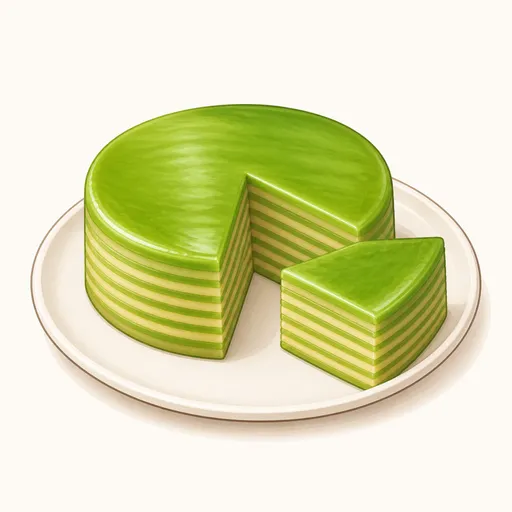
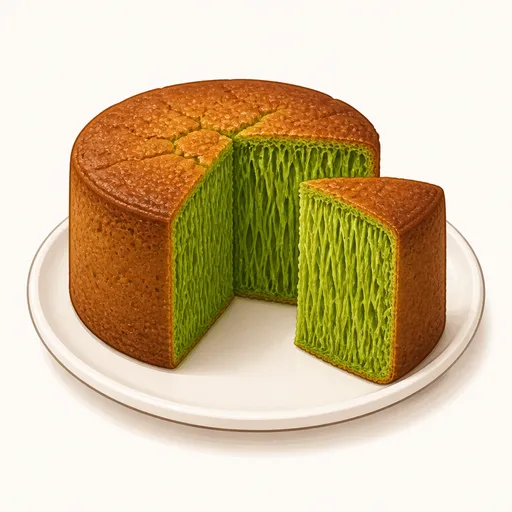
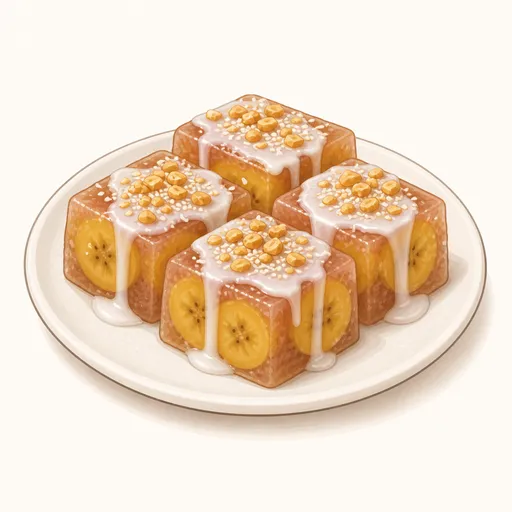
Baked coconut egg custard cake (banh gan)
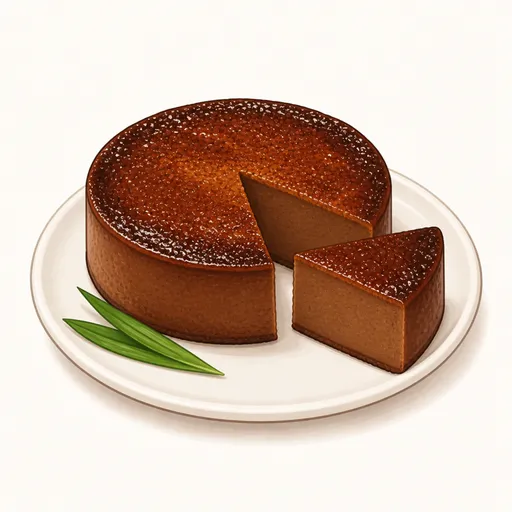
Banh gan is a homey cake from southern Vietnam, named after liver because once baked it turns a deep brown and becomes as smooth as liver. Made with just eggs, coconut milk, palm sugar and pandan leaves, it is rich and creamy, fragrant with lightly caramelized palm sugar, with a silky texture somewhere between a flan and a baked cake.
- Difficulty
- Easy
- Prep
- 25 min
- Cook
- 1 hr 10 min
- Rising or chilling
- 2 hr
- Total time
- 3 hr 35 min
- Method
- Oven-baked
Ingredients
Egg and coconut milk custard
Pandan leaves for aroma
Greasing the pan
Instructions
Step 1
Put 400 g coconut milk, 140 g chopped palm sugar, a pinch of salt and 20 g knotted pandan leaves in a saucepan and heat over low heat for about ten minutes, then remove the leaves and let it cool slightly. Gentle heat dissolves all the sugar and infuses the coconut milk with the aroma of pandan. The mixture is ready when it is light brown, fragrant with pandan and only just warm.
Step 2
Preheat the oven to 160 degrees Celsius, grease a 20 cm round pan with vegetable oil (to taste) and set it inside a larger tray. The outer tray will hold hot water so the cake cooks slowly in a moist environment. The oven is ready when it has held a steady temperature for at least ten minutes.
Step 3
Crack 300 g eggs into a bowl and stir gently in one direction with a whisk until the yolks and whites are evenly blended. Stirring gently instead of beating hard keeps the mixture from foaming, so the cake is smooth with no holes. The eggs are ready when they are an even yellow with almost no foam on top.
Step 4
Slowly pour the warm coconut milk into the eggs in a thin stream, stirring steadily as you pour. Pouring slowly warms the eggs gradually so they don't curdle into lumps. The mixture is ready when it is smooth, golden brown and as silky as milk.
Step 5
Strain the mixture twice through a fine sieve into the prepared pan, then dab the surface gently with paper towels to lift off all the foam. Careful straining removes the egg membranes and air bubbles, giving a cake as smooth as silk. The mixture is ready when the surface is still and free of tiny bubbles.
Step 6
Pour hot water into the outer tray to come about halfway up the side of the pan and bake at 160 degrees Celsius for about 60 to 75 minutes. The surrounding hot water helps the cake cook evenly and turn deep brown on top without becoming pitted. It is done when the top is a deep chestnut brown, the center only wobbles slightly when you gently shake the pan and a toothpick comes out clean.
Step 7
Lift the pan out of the water, let it cool to room temperature, then refrigerate for about two hours. Once completely cool, the cake sets more firmly and cuts into neat slices. It is ready when it is chilled right through to the center and the edges have pulled slightly away from the pan.
Step 8
Run a thin knife around the edge of the pan, turn the cake out onto a plate and cut it into triangles or squares. Dipping the knife in hot water and wiping it dry between cuts gives smooth, clean slices. The slices are ready when they stand firmly with evenly golden brown cut sides and no holes.
Equipment
- Oven
- Round cake pan
- Baking sheet
- Small saucepan
- Whisk
- Sieve
- Mixing bowl
- Kitchen scale
Tips
- You can replace half of the chicken eggs with duck eggs for a richer cake with a deeper color, as in the traditional recipe.
- If you like a darker top, switch the oven to top heat at 180 degrees Celsius for the last five minutes and watch closely so it doesn't burn.
- Palm sugar in cakes or blocks should be chopped or grated first so it dissolves quickly when heated with the coconut milk.
Storage
Banh gan keeps for three days in the fridge, tightly covered with plastic wrap. It is best eaten chilled; don't leave it at room temperature for more than two hours, since it contains eggs and coconut milk.
Common problems and how to fix them
- The inside of the cake is full of holes like a honeycomb.
- The oven was too hot or the mixture had too much foam. Stir the eggs gently, strain carefully and lower the oven to 150 degrees Celsius, baking a little longer.
- Liquid separates out at the bottom of the cake.
- The cake was overbaked, so the eggs tightened and wept. Check it sooner and take it out while the center still wobbles slightly.
This recipe is based on the common ratios for this bake and is written entirely in our own words.