Ramie leaf sticky rice cakes (banh gai)
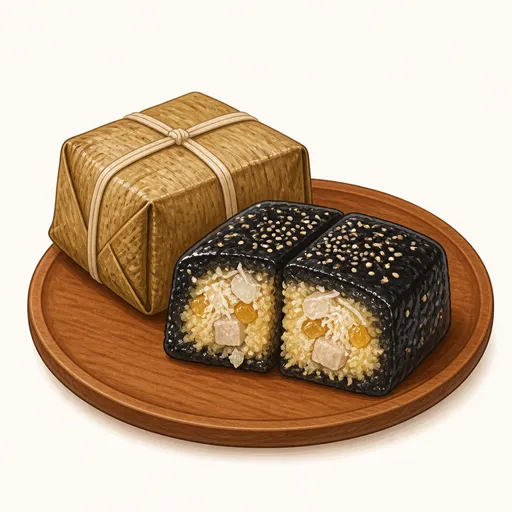
Banh gai are the renowned specialty of Ninh Giang and Tu Tru, with a glossy black, chewy shell made from ramie leaves pounded with glutinous rice flour and fragrant with the leaves. Inside is a rich, sweet filling of mung beans, coconut, pork fat and candied winter melon, while the outside is sprinkled with sesame and wrapped in dried banana leaves.
- Difficulty
- Hard
- Prep
- 2 hr
- Cook
- 1 hr
- Rising or chilling
- 4 hr
- Total time
- 7 hr
- Method
- Steamed
Ingredients
Ramie leaf shell
Filling
Topping
Wrapping leaves
Instructions
Step 1
Rinse 200 g split peeled mung beans, then soak them, fully covered, for about three hours. Softened beans cook quickly and make a smooth filling. They are ready when they have swollen and break apart easily when pinched between your fingers.
Step 2
Put 200 g boiled and well-squeezed ramie leaves in a blender with 40 g water and blend until very smooth. The finer the leaves, the silkier the shell, with no flecks of leaf fiber. The leaves are ready when they form a thick, greenish black paste with no strands when rubbed between two fingers.
Step 3
Put the blended ramie leaves in a pan with 250 g granulated sugar and 40 g maltose and cook over low heat for about ten minutes, stirring constantly. The sugar and maltose blend into the leaves to make the shell glossy and chewy and keep it from tasting sour. The paste is ready when it is thick, glossy black and stretches into pliable strands when lifted.
Step 4
Let the cooked leaf paste cool until just warm, then mix it with 500 g glutinous rice flour and knead vigorously for about ten minutes, cover tightly and let it rest for about 30 minutes. Thorough kneading colors the glutinous rice flour evenly with the leaves and makes it pliable enough to wrap the filling. The dough is ready when it is evenly jet black, smooth and doesn't stick to your hands.
Step 5
Steam the soaked beans for about 25 minutes until very soft, then mash them smoothly. Dry-steamed beans give a nutty filling that cooks down quickly and holds its shape in balls. They are ready when they mash evenly smooth with no hard bits left.
Step 6
Cook the mashed beans with 100 g granulated sugar over low heat until almost dry, turn off the heat, then mix in 100 g freshly grated coconut, 80 g lard and 50 g diced candied winter melon and divide into fourteen balls. The fat and candied winter melon make the filling rich and gently sweet, just like traditional banh gai. The balls are ready when they are firm and round, with the fat and candied melon evenly distributed.
Step 7
Cut 300 g dried banana leaves into squares, wipe them clean, then brush a thin layer of vegetable oil (to taste) over the inner side and sprinkle 20 g white sesame seeds over the oil. The oil holds the sesame on the shell and keeps the cakes from sticking to the leaves when unwrapped. The leaves are ready when a light, even layer of sesame covers the center.
Step 8
Divide the dough into fourteen pieces, press each one thin in an oiled palm, place a ball of filling inside, then wrap it completely and pat it into a flat square. A flat square shape helps the cakes cook evenly from the outside to the filling. They are ready when the shell is evenly thick on all four sides with no cracks.
Step 9
Place each cake on a sesame-sprinkled leaf, fold the leaf into a square parcel and tie it tightly with string. Wrapping tightly helps the cakes keep their square shape during steaming and keeps water from seeping in. They are ready when the parcels are neat and the leaves don't shift when pressed lightly.
Step 10
Arrange the cakes in the steamer once the water is at a rolling boil and steam over high heat for about 50 minutes, topping up the pot with boiling water if it runs low. The thick glutinous rice shell needs to steam long enough to cook right through to the layer next to the filling. They are done when an opened cake shows a glossy, more translucent shell that feels chewy and springy when pressed.
Step 11
Lift out the cakes and hang them or stand them upright on a rack to cool and drain for about an hour. As the cakes cool, the shell firms up, so they cut cleanly without sticking to the knife. They are ready when the leaves are dry and the shell is no longer wet and sticky when unwrapped.
Equipment
- Steamer
- Blender
- Small saucepan
- Nonstick skillet
- Mixing bowl
- Kitchen twine
- Kitchen scale
Tips
- Dried ramie leaves must be boiled thoroughly, rinsed in several changes of water and squeezed completely dry before blending so the shell doesn't taste astringent.
- Traditionally, diced pork fatback marinated in sugar overnight is used; if you have it, use it instead of the lard for a richer filling with more bite.
- Banh gai get chewier and more fragrant a day after steaming, so make them a day ahead if you are giving them as gifts.
Storage
Banh gai keep for about three days in a cool, airy spot at room temperature. You can refrigerate them for up to a week; to serve, steam them for about ten minutes so the shell turns soft and chewy again.
Common problems and how to fix them
- The shell turns hard and cracks after cooling.
- The dough was too dry or the cakes weren't steamed long enough. Knead a little more cooked leaf paste into the dough and steam for the full fifty minutes over high heat.
- The shell is too soft and the cakes slump flat while steaming.
- The blended leaves still held too much water or the paste wasn't cooked thick enough. Squeeze the leaves completely dry before blending and cook the paste until it stretches into strands.
This recipe is based on the common ratios for this bake and is written entirely in our own words.