Snow skin mooncakes (banh deo)
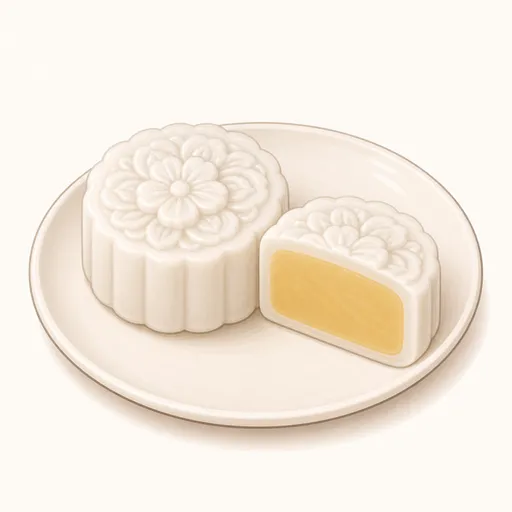
Banh deo are the snow-white siblings of baked mooncakes at the Mid-Autumn Festival, with a soft, chewy, delicately sweet skin and a faint scent of pomelo blossom. They need no oven at all, just a syrup cooked to the right stage, roasted glutinous rice flour and a patterned mooncake mold.
- Difficulty
- Medium
- Prep
- 1 hr 30 min
- Cook
- 40 min
- Rising or chilling
- 10 hr
- Total time
- 12 hr 10 min
- Method
- No cooking
Ingredients
Snow skin
Mung bean filling
Dusting flour
Instructions
Step 1
Put 200 g granulated sugar and 240 g water in a saucepan and heat over medium heat until the sugar dissolves, add 4 g lime juice, then let it simmer gently for about ten minutes without stirring. The lime juice keeps the sugar from recrystallizing, so the skin stays soft and smooth for days. The syrup is ready when it is crystal clear, slightly thickened and a drop in a bowl of cold water spreads gently instead of dissolving right away.
Step 2
Turn off the heat, let the syrup cool naturally, then add 1 g pomelo blossom essence, cover tightly and leave it at room temperature for at least eight hours. A syrup that rests long enough stabilizes, giving a skin that is soft without running. The syrup is ready when it is completely cool and clear with no sugar crystals at the bottom.
Step 3
Rinse 180 g split peeled mung beans in several changes of water, then soak them for about three hours. Beans that have absorbed water cook evenly soft from the inside out. They are ready when they have nearly doubled in size and feel soft when pressed with a fingernail.
Step 4
Drain the beans very well and steam them for about 25 minutes, stirring once halfway through so all the layers cook evenly. Steamed beans hold little water, so they dry quickly when cooked into a paste and keep their bright yellow color. They are done when they crumble under light pressure from a chopstick.
Step 5
Blend the beans until smooth and put them in a pan with 120 g granulated sugar and 25 g vegetable oil added in three portions, stirring constantly over low heat, and add 1 g pomelo blossom essence near the end. Adding the oil a little at a time makes the filling glossy and smooth and stops the sugar from crystallizing. The filling is ready when it pulls away from the pan in a single pliable mass and, once cooled, doesn't stick to your fingers when rolled.
Step 6
Divide the cooled filling into eight equal portions, roll each one into a tight ball and cover with plastic wrap. Tightly rolled filling lets the skin wrap snugly with no air gaps inside. The balls are ready when they are smooth and round with no small cracks on the surface.
Step 7
Sift 200 g roasted glutinous rice flour into a bowl, pour the syrup into the center a little at a time and mix with your hands, pressing and kneading until it comes together into a dough. Adding the syrup gradually lets you stop exactly when the skin is pliable, because every batch of roasted flour absorbs liquid differently. The skin is ready when it is soft, smooth and slightly tacky, and a fingertip pressed into it leaves a dent that slowly fills back in.
Step 8
Rub a little dusting flour (to taste) on your hands, divide the skin into eight portions, press each one thin, place a ball of filling in the middle, then draw the edges up to enclose it completely and roll it smooth. The dusting flour prevents sticking, but use only a little so the skin doesn't dry out on the surface. The cakes are ready when the skin covers the filling evenly, is equally thin all around and the seam is completely sealed.
Step 9
Dust the inside of the mold with a thin layer of dusting flour, tap out the excess, place a ball inside, press it down firmly on the work surface and then lift the mold off gently. Even pressure brings out the pattern clearly and gives the cake flat sides. The cakes are ready when the pattern is crisp and they stand firmly without slumping.
Step 10
Arrange the cakes on a tray, cover them tightly with plastic wrap and leave them at room temperature for about two hours before eating or packaging. As they rest, the moisture in the filling and skin evens out, so the cakes turn softer and chewier. They are ready when the skin is smooth and no dry dusting flour remains on the pattern.
Equipment
- Mooncake mold
- Small saucepan
- Steamer
- Nonstick skillet
- Mixing bowl
- Spatula
- Plastic wrap
- Kitchen scale
Tips
- You can replace some of the mung bean filling with sweet lotus seed paste or steamed taro to get several flavors in one batch.
- If the skin is too sticky, don't rush to add more flour; let the dough rest in a covered bowl for about ten minutes and the flour will absorb some of the syrup, making it easier to wrap.
- Pomelo blossom essence is very strong, so add it drop by drop and smell as you go, because too much will make the cakes slightly bitter.
Storage
Banh deo are best within the first three days, kept in a sealed bag at room temperature. Don't refrigerate them, as the skin will harden; if you do chill them, leave them out for about an hour before eating.
Common problems and how to fix them
- The skin turns hard and dry after a day.
- The syrup was cooked too far or too much dusting flour was used. Next time, simmer the syrup gently for just ten minutes and dust only very lightly.
- The cakes slump and the pattern loses its definition.
- The skin was too wet from too much syrup. Sift a little more roasted glutinous rice flour into the dough and knead it again until it holds an indentation.
This recipe is based on the common ratios for this bake and is written entirely in our own words.