Mung bean cakes (banh dau xanh)
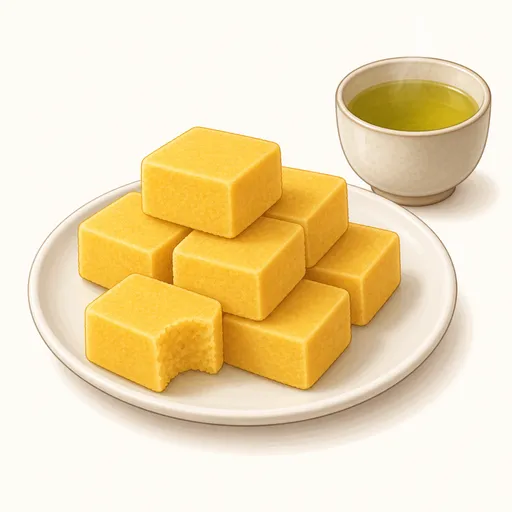
Banh dau xanh are the famous specialty of Hai Duong: small, golden blocks that melt on your tongue with a delicate sweetness, a gentle richness and a faint scent of pomelo blossom. They are made from steamed mung beans that are dried and ground to a fine powder, then mixed with sugar and fat and pressed into molds. These little cakes are especially lovely with a cup of hot green tea.
- Difficulty
- Medium
- Prep
- 1 hr
- Cook
- 1 hr
- Rising or chilling
- 5 hr
- Total time
- 7 hr
- Method
- Steamed
Ingredients
Instructions
Step 1
Rinse 300 g split peeled mung beans, soak them in cold water for about four hours, then rinse again to wash away any remaining skins and drain. Well-soaked beans cook evenly and give a fine, bright yellow powder. They are ready when they have swollen and are evenly soft all the way through when broken in half.
Step 2
Spread the beans in a thin layer in a steamer lined with cheesecloth and steam over high heat for about 25 minutes. Steaming rather than boiling keeps the beans from absorbing water, so the drying step goes faster. They are done when the beans are still whole but crumble to powder when pressed lightly.
Step 3
Put the steamed beans in a nonstick pan and stir constantly over very low heat for about 25 minutes until all the moisture has evaporated, then spread them on a tray to cool completely. The beans must be thoroughly dry to grind into a loose, lump-free powder. They are ready when the beans are separate, feel dry and slightly crunchy and are pale yellow without any browning.
Step 4
Grind the dried beans into a very fine powder in a spice or dry grinder, then sift it through a fine-mesh sieve and grind any remaining bits again. The finer the powder, the faster the cakes melt in your mouth, just like true Hai Duong mung bean cakes. The powder is ready when it feels as silky as chalk between your fingertips, with no grittiness at all.
Step 5
Melt 60 g lard and let it cool to warm, mix the bean powder with 180 g powdered sugar, then slowly drizzle in the lard along with a pinch of pomelo blossom essence and work it together evenly with your hands. The fat coats every grain of powder, binding the cakes and giving them their characteristic richness. The mixture is ready when it holds together in a firm clump when squeezed and keeps its shape when released, only crumbling slightly at the edges.
Step 6
Dust the inside of the mold with a thin layer of the powder, fill it with the mixture, press down very firmly with a pestle or flat lid, level the top and tap gently to release the cake. Firm pressing gives neat, square blocks that don't crumble when you pick them up. The cakes are ready when they have sharp edges, a smooth surface and no cracks.
Step 7
Arrange the cakes on a tray and leave them in a dry, airy place for about an hour so the fat sets, then wrap each block in foil or parchment paper. The rest lets the surface firm up so the cakes are sturdier for wrapping. They are ready when they no longer stick to your fingers and hold their shape when picked up.
Equipment
- Steamer
- Nonstick skillet
- Food processor
- Sieve
- Shaping molds
- Spatula
- Kitchen scale
- Mixing bowl
Tips
- If you'd rather not use lard, you can substitute a neutral-tasting vegetable oil; the cakes will be slightly softer but still delicious.
- Don't use high heat when drying the beans, because as soon as they brown, the cakes will taste scorched and lose their lovely yellow color.
- If you don't have a special mold, press the mixture into a square pan and cut it into small blocks with a sharp knife.
Storage
Wrapped in paper and stored in an airtight container in a cool, dry place, the cakes keep for about two weeks. Avoid humid spots, because mung bean powder absorbs moisture very easily and turns soft and mushy.
Common problems and how to fix them
- The cakes crumble when you take them out of the mold.
- The mixture didn't have enough fat or wasn't pressed firmly enough. Work a little more warm lard into the powder and press harder.
- The cakes taste gritty and don't melt in your mouth.
- The beans weren't dry enough when ground or weren't sifted thoroughly. Dry the beans longer over low heat and sift the powder twice before mixing.
This recipe is based on the common ratios for this bake and is written entirely in our own words.