Sticky rice balls in ginger syrup (banh chay)
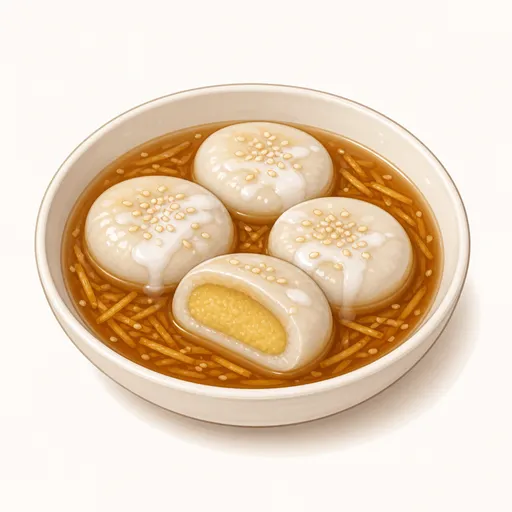
Banh chay are the sibling of banh troi, with the same soft glutinous rice shell but bigger, flatter and stuffed with a rich, nutty mung bean filling. They float in a bowl of lightly thickened brown sugar syrup warmed with ginger, sprinkled with toasted sesame and, if you like, finished with a drizzle of coconut milk for extra richness.
- Difficulty
- Medium
- Prep
- 50 min
- Cook
- 40 min
- Rising or chilling
- 2 hr
- Total time
- 3 hr 30 min
- Method
- Boiled or simmered
Ingredients
Glutinous rice dough
Mung bean filling
Ginger syrup
Toppings
Instructions
Step 1
Rinse 120 g split peeled mung beans in several changes of water, then soak them, fully covered, for about two hours. Beans soaked long enough steam quickly and make a smooth, nutty filling. They are ready when they are plump and snap in half easily when pinched with a fingernail.
Step 2
Steam the beans for about 25 minutes until very soft, mash them smoothly while hot, then mix in 35 g granulated sugar and a pinch of salt and stir in a pan over low heat until the filling dries out. A dry enough filling is easy to roll and won't make the shells soggy. It is ready when it gathers into a pliable mass that you can roll into balls the size of a small jujube without it sticking to your hands.
Step 3
Mix 300 g glutinous rice flour with 230 g warm water, adding the water gradually and kneading until the dough is soft and smooth, then cover it and let it rest while you roll the filling. A dough with enough moisture can wrap a large ball of filling without cracking. It is ready when a small piece squeezed between your fingers doesn't crack at the edges or stick to your hands.
Step 4
Divide the dough into pieces slightly larger than the balls of filling, press each one thin, place a ball of filling in the middle, then seal it and press gently into a flattened round. Flattened cakes cook through more quickly and evenly and are easier to eat from a bowl. They are ready when the shell is evenly thick, no filling shows and each one is about 4 cm across.
Step 5
Drop the cakes into a pot of boiling water, stir gently so they don't stick to the bottom and cook over medium heat for about six minutes, then transfer them to a bowl of cool water. The cool water firms up the shells and keeps them chewy. They are done when they have floated on the surface for an extra minute and the shells look evenly translucent.
Step 6
Peel 25 g fresh ginger and cut it into fine matchsticks, then put it in a saucepan with 180 g brown sugar and 600 g water and simmer over medium heat for about ten minutes. A slightly longer simmer lets the warm heat of the ginger infuse the syrup. The syrup is ready when it is amber brown and smells strongly of ginger.
Step 7
Stir 20 g tapioca starch into a little cold water, turn the heat down to low, then slowly pour it into the syrup while stirring constantly. Constant stirring keeps the starch from clumping and makes the syrup silky. The syrup is ready when it turns clear again and is lightly thickened, coating the back of a spoon thinly.
Step 8
Lift the cakes out of the cool water into the ginger syrup and keep it at a gentle simmer over low heat for about three minutes. Simmering them together warms the shells back up and lets them take on a little of the sweet, spicy flavor. They are ready when they are heated through and the shells glisten with syrup.
Step 9
Ladle the cakes and syrup into bowls, sprinkle 15 g toasted white sesame seeds on top and drizzle with 120 g coconut milk if you like. The sesame and coconut milk add a nutty richness that balances the spicy ginger. Each bowl is complete when it holds three or four cakes immersed in the thickened syrup.
Equipment
- Small saucepan
- Steamer
- Mixing bowl
- Kitchen scale
- Nonstick skillet
- Plastic wrap
Tips
- Toast the sesame in a dry pan over low heat until ivory gold before sprinkling, so the seeds are crunchier and more fragrant.
- You can use kudzu starch instead of tapioca starch for a clearer, more refreshing syrup in the northern Vietnamese style.
- Warm the coconut milk with a pinch of salt and a little sugar before drizzling for a better balance of rich, salty and sweet.
Storage
The cakes and syrup are best eaten on the day they are made. If you have leftovers, keep the cakes and syrup in separate airtight containers in a cool spot at room temperature until the end of the day, then reheat them together for a few minutes so the shells soften again.
Common problems and how to fix them
- The syrup has lumps of starch in it.
- The tapioca starch was added too quickly or the syrup was boiling hard. Lower the heat, dissolve the starch completely and pour it in a thin stream while stirring constantly.
- The shells turn mushy and stick together in the pot.
- The cakes sat in the syrup for too long. Add them to the syrup only just before serving and keep them in cool water until then.
This recipe is based on the common ratios for this bake and is written entirely in our own words.