Clay-pan rice cakes (banh can)
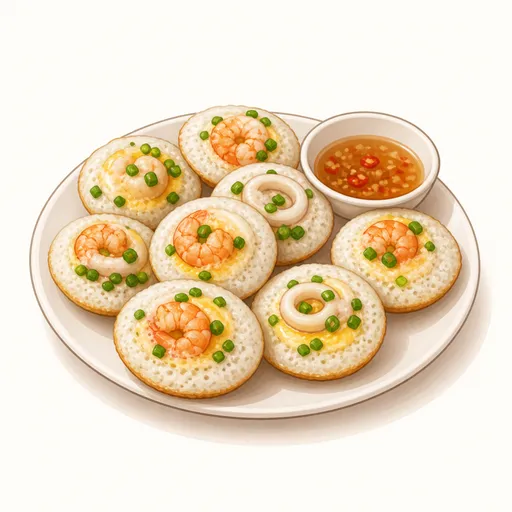
Banh can are little rice cakes cooked in clay molds, a specialty of south central Vietnam that is especially famous in Phan Rang and Nha Trang. They use far less oil than banh khot, so the outside is only lightly crisp while the inside stays soft, fluffy and fragrant with rice, crowned with egg, shrimp or fresh squid. Dip them in a light fish sauce with scallions to enjoy them at their best.
- Difficulty
- Medium
- Prep
- 30 min
- Cook
- 45 min
- Rising or chilling
- 2 hr
- Total time
- 3 hr 15 min
- Method
- Pan-cooked or waffle iron
Ingredients
Banh can batter
Egg, shrimp and squid
Fish dipping sauce
Instructions
Step 1
Mix 220 g rice flour with a pinch of salt, slowly pour in 420 g water and stir until there are absolutely no lumps left. Banh can need only rice flour and water, so thorough mixing is the key to smooth, fluffy cakes. The batter is ready when it is as thin as thick rice water and drips steadily from a spoon.
Step 2
Cover the bowl tightly and leave it at room temperature for about two hours, stirring once halfway through. The long rest lets the rice flour ferment slightly and swell, giving the cakes a fluffy crumb with tiny air holes. The batter is ready when a few tiny bubbles appear on the surface and it smells mildly of rice.
Step 3
Peel 150 g fresh shrimp, clean 150 g fresh squid and cut it into small rings that fit the molds, finely slice 30 g scallions and crack 150 g eggs into a bowl. Cutting the seafood small lets it cook at the same pace as the cakes without turning rubbery. Everything is ready when it is portioned out next to the stove so you can work quickly.
Step 4
Set the banh can mold over medium heat, use a cloth or brush dipped in a little vegetable oil (to taste) to wipe each cavity lightly and wait about five minutes. A clay mold takes time to heat evenly, and if you pour in the batter too soon the cakes will stick and won't rise. The mold is ready when a drop of water sizzles and evaporates instantly in a cavity.
Step 5
Pour batter into each cavity until about two thirds full, wait a few seconds for the bottom to set, then add a little egg, shrimp or squid on top, cover with the clay lid and cook for about five minutes. The lid traps the heat so the tops cook in the steam while the hot mold forms a pale golden crust underneath. The cakes are done when the tops look dry, the egg has set and they scoop out with pale golden, lightly crisp bottoms.
Step 6
Heat 120 g water with 30 g granulated sugar and 40 g fish sauce over low heat until it just simmers, turn off the heat and let it cool, then add 15 g lime juice and 5 g minced garlic. The sauce for banh can is mixed thin so you can dunk whole cakes in the bowl to soak it up. The sauce is ready when it is clear and golden, lightly salty and sweet and not harsh.
Step 7
Scoop the cakes onto a plate, sandwich them together in pairs if you like, sprinkle with scallions and serve with the bowl of fish sauce. They are best eaten hot, while the outside is still lightly crisp and the inside soft and fluffy. They are ready when the scallions have just wilted on the hot cakes and smell fragrant.
Equipment
- Small cup molds
- Mixing bowl
- Whisk
- Small saucepan
- Kitchen scale
Tips
- If you don't have a clay mold, you can use a cast-iron banh khot pan, but wipe it with only a very thin film of oil so the cakes don't fry crisp like banh khot.
- Some cooks blend a handful of day-old cooked rice into the batter for softer, fluffier cakes; give it a try once you are comfortable with the recipe.
- Serving them with scallion oil, shredded green mango or meatballs in broth makes the meal even more generous.
Storage
Banh can are best straight out of the mold. Leftover batter can be kept in the fridge for about a day, but let it come back to room temperature and stir it well before cooking.
Common problems and how to fix them
- The cakes are hard and dense with no air holes inside.
- The batter didn't rest long enough or was too thick. Let it rest longer and add a little water if it is thicker than thick rice water.
- The cakes stick firmly to the mold and won't scoop out.
- The mold wasn't hot enough or wasn't oiled. Heat the mold longer and wipe on a thin layer of oil every few batches.
This recipe is based on the common ratios for this bake and is written entirely in our own words.