Sesame balls with mung bean filling (banh cam)
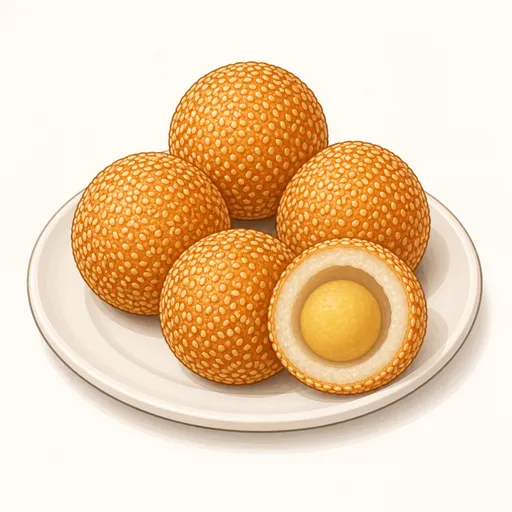
Banh cam are a favorite snack in southern Vietnam: plump, round balls covered in sesame seeds and fried until they glow golden like ripe oranges. The outer shell is shatteringly crisp, and the chewy, slightly hollow glutinous rice layer inside hugs a sweet, nutty ball of mung bean filling at the center.
- Difficulty
- Medium
- Prep
- 1 hr
- Cook
- 30 min
- Rising or chilling
- 2 hr 30 min
- Total time
- 4 hr
- Method
- Fried
Ingredients
Dough
Mung bean filling
Sesame coating
Frying oil
Instructions
Step 1
Rinse 150 g split peeled mung beans and soak them in warm water for about two hours, then steam them until very soft. Well-soaked, thoroughly steamed beans make a filling as smooth as powder. The beans are ready when they crumble under the tip of a chopstick with no hard core.
Step 2
Blend or mash the beans until very smooth, put them in a nonstick pan with 70 g granulated sugar, 10 g vegetable oil and a pinch of salt, and stir over low heat for about ten minutes. Cooking the paste until dry helps it hold its shape and keeps it from making the dough soggy during frying. The filling is ready when it gathers into a smooth mass that doesn't stick to the pan; let it cool, then roll it into sixteen balls.
Step 3
Peel the potatoes, steam them for about 20 minutes until tender, then mash them very smoothly while still hot and weigh out 100 g mashed potato. Potato makes the shell soft and puffy and helps it stay crisp longer. The potato is ready when it is as smooth as cream with no small lumps.
Step 4
Mix 250 g glutinous rice flour, 50 g rice flour, 60 g granulated sugar, 4 g baking powder and a pinch of salt, add the mashed potato, then gradually pour in 170 g warm water while kneading. The rice flour makes the shell crisp, while the baking powder creates the light, hollow space inside each ball. The dough is ready when it is soft, smooth, pliable like modeling clay and doesn't stick to your hands.
Step 5
Wrap the dough in plastic wrap and let it rest for about 30 minutes at room temperature. The rest gently activates the baking powder and lets the water spread evenly. The dough is ready when the surface is smooth and it feels soft and springy when pressed lightly.
Step 6
Divide the dough into sixteen pieces, press each one thin into a cup shape, place a ball of filling inside, then close the opening and roll it into a tightly sealed ball. An evenly thick shell lets the balls puff up round without cracking. They are ready when they are smooth and round with no gaps and slightly larger than a quail egg.
Step 7
Quickly dip each ball in a bowl of water, roll it in 60 g white sesame seeds, then roll it firmly between your palms again. Rolling it again presses the sesame on so it doesn't fall off in the hot oil. The balls are ready when the sesame covers the surface in an even layer.
Step 8
Heat the oil for deep-frying (to taste) to about 130 degrees Celsius, add the balls and fry over low heat for about ten minutes, gently pressing and rolling them constantly with a ladle. The warm oil and the pressing and rolling make the balls puff up gradually from the inside out. They are ready when they have nearly doubled in size and float to the surface.
Step 9
Raise the heat to medium so the oil reaches about 160 degrees Celsius and fry for a few minutes more, still turning them so they turn golden on every side. The higher heat at the end makes the shell hard and crisp and sets the round shape. They are done when the shell is a deep golden orange and feels hard and crisp when tapped.
Step 10
Lift the balls into a colander or onto a rack lined with paper towels and let them cool for about five minutes. Draining keeps the shell from going soft from pooled oil. They are ready when the surface is dry and they still feel plump, round and crisp when you pick them up.
Equipment
- Deep skillet
- Thermometer
- Steamer
- Mixing bowl
- Nonstick skillet
- Kitchen scale
- Plastic wrap
- Wire cooling rack
Tips
- Don't put the balls into very hot oil right at the start, or the shell will harden before it can puff and the balls will collapse and crack.
- You can replace the potato with orange-fleshed sweet potato for a deeper orange shell and a sweeter flavor.
- For the syrup-glazed Mekong Delta style, cook brown sugar with a little ginger into a syrup and quickly toss the freshly fried balls in it.
Storage
Banh cam are crispiest in the first few hours. You can keep them in a loosely covered container at room temperature until the end of the day, then reheat them in an air fryer or a 160 degree Celsius oven for about five minutes.
Common problems and how to fix them
- The balls collapse right after you take them out.
- They weren't fried long enough at the end, so the shell wasn't firm enough. Fry for a few more minutes over medium heat until the shell is deep golden and feels hard when tapped.
- The balls crack and the filling bursts out in the pan.
- The oil was too hot or the dough was dry. Lower the oil temperature, keep the dough under a damp towel while shaping and knead in a little water only if the edges start to crack.
This recipe is based on the common ratios for this bake and is written entirely in our own words.