Cantonese white sugar sponge cake (bak tong gou)
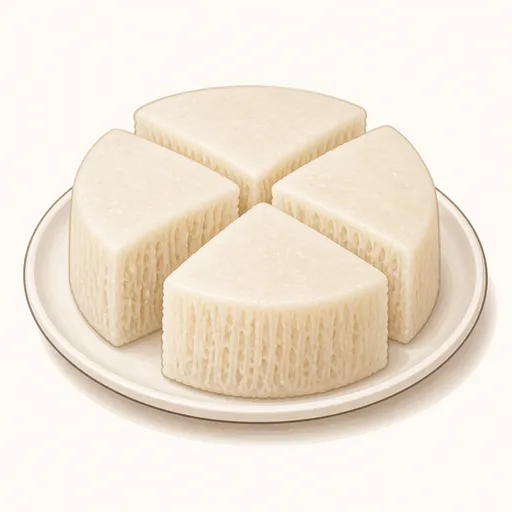
Bak tong gou is an ivory-white Cantonese steamed cake made from fermented rice flour and white granulated sugar. It is delicately sweet with a faint tang from the yeast, and its soft, springy crumb is full of tiny air holes lined up in vertical strands like a honeycomb. Unlike Vietnamese steamed rice cakes (banh bo), it contains no coconut milk, so the flavor is very clean and light.
- Difficulty
- Medium
- Prep
- 20 min
- Cook
- 30 min
- Rising or chilling
- 4 hr
- Total time
- 4 hr 50 min
- Method
- Steamed
Ingredients
Rice flour batter
Sugar syrup
Oil for the pan
Instructions
Step 1
Put 300 g rice flour in a heatproof bowl, pour in 230 g cold water and whisk until completely dissolved. Wetting the flour with cold water first keeps the starch from clumping when the boiling syrup goes in. The mixture is ready when it is smooth and runny like milk with no flour left at the bottom of the bowl.
Step 2
Heat 200 g granulated sugar with 230 g water over medium heat, stirring until the sugar dissolves, then let it come to a rolling boil for about a minute. The syrup must be truly boiling so that it partly cooks the batter when you pour it in. The syrup is ready when it is perfectly clear with large bubbles across the whole surface.
Step 3
While stirring the rice flour mixture constantly, pour in the boiling syrup slowly in a thin stream. Partly cooked batter develops a soft chewiness and helps the cake hold its air holes. The batter is ready when it has thickened slightly and is glossy, smooth and an even opaque white.
Step 4
Let the batter cool to about 35 to 40°C, sprinkle in 4 g instant yeast and stir until dissolved, then strain the mixture through a sieve. Batter that is too hot will kill the yeast, and straining removes any undissolved granules. The mixture is ready when it feels comfortably warm on your wrist and is smooth with no lumps.
Step 5
Cover the bowl tightly with plastic wrap and leave it somewhere warm, around 30°C, for three to four hours. Fermentation produces the gas and the gentle tang that are the very soul of this cake. The batter is ready when the surface is covered in tiny bubbles and it smells faintly like sweet rice wine.
Step 6
Brush to taste vegetable oil inside a 20 cm round pan, set the pan in a steamer at a rolling boil and heat it for three minutes, give the batter a few gentle stirs, then pour it into the hot pan and steam over high heat for about thirty minutes. A hot pan and strong steam make the batter spring up at once, forming beautiful vertical strands of air holes. The cake is done when the top is smooth and taut, turning a translucent ivory, and a bamboo skewer comes out clean.
Step 7
Let the cake cool completely in the pan, run an oiled knife around the edge, then turn it out and cut it into triangles or diamonds. The hot cake is very sticky, and it only firms up enough to cut cleanly once the inside has cooled. It is right when the cut surface shows clear lines of air holes running vertically like a honeycomb and the cake springs back when pressed.
Equipment
- Steamer
- Round cake pan
- Small saucepan
- Whisk
- Sieve
- Thermometer
- Mixing bowl
- Kitchen scale
- Plastic wrap
Tips
- Use finely milled regular rice flour, not glutinous rice flour, which would make the cake gummy with no air holes.
- If your home is cold, set the bowl in a switched-off oven with the light on to keep the temperature steady while it ferments.
- Do not open the steamer lid during the first fifteen minutes, because a sudden drop in temperature will stop the cake from rising.
Storage
The cake is best on the day it is made, kept in an airtight container at room temperature. You can refrigerate it for two days, but it will firm up, so steam it again for about five minutes to soften it.
Common problems and how to fix them
- The cake has no air holes and is dense and rubbery.
- The yeast did not rise enough or was killed by batter that was too hot. Check the temperature with a thermometer before adding the yeast and extend the fermentation until you see lots of bubbles.
- The cake smells harshly sour.
- The batter fermented too long or somewhere too hot. Shorten the fermentation or set the bowl somewhere a little cooler.
This recipe is based on the common ratios for this bake and is written entirely in our own words.