Angel food cake
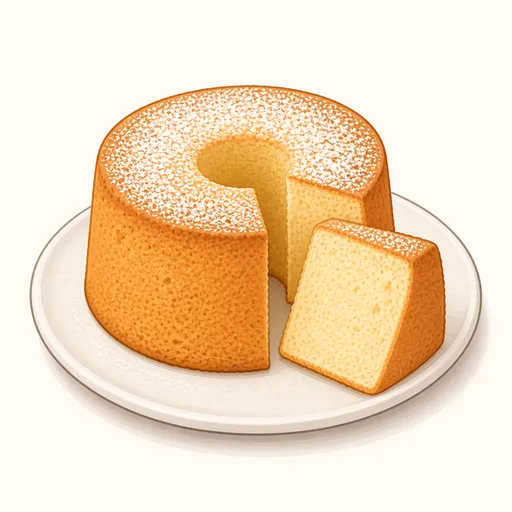
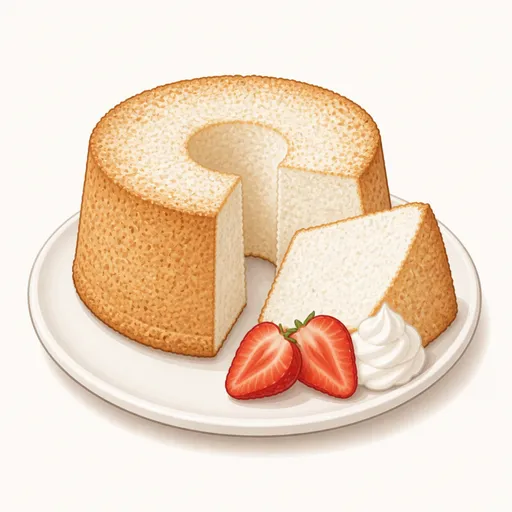
Angel food cake is America's snow-white sponge, made only with egg whites and no yolks, butter or oil at all. The crumb is white as a cloud, light, airy and pleasantly springy, with a gentle sweetness and hints of vanilla and lemon. It is classically served with fresh strawberries and a little whipped cream.
- Difficulty
- Medium
- Prep
- 30 min
- Cook
- 40 min
- Rising or chilling
- 2 hr
- Total time
- 3 hr 10 min
- Method
- Oven-baked
Ingredients
Dry mixture
Whipped egg whites (meringue)
Instructions
Step 1
Set a rack in the lowest position and preheat the oven to 175°C, and have ready a 25 cm tube pan that is perfectly clean, dry and absolutely ungreased. Clean sides give the batter something to cling to as it climbs, and they keep the cake from sliding out when it hangs upside down. The pan is ready when it feels dry with no trace of oil or grease.
Step 2
Sift 125 g cake flour with 100 g powdered sugar and a pinch salt three times in a row onto a large sheet of paper. Repeated sifting makes the flour very light and airy and blends it evenly with the sugar, so it will not clump when sprinkled over the meringue. It is ready when it is as fine as powder with no coarse bits left in the sieve.
Step 3
Beat 360 g egg whites on low speed until foamy, add 4 g cream of tartar and 5 g lemon juice, increase to medium speed and add 200 g superfine sugar gradually, a spoonful at a time, then finish with 5 g vanilla extract. Angel food needs a meringue that is just soft enough, because overwhipped whites turn dry and their bubbles burst when the flour goes in. The meringue is ready when it is glossy and smooth, and the peak on the lifted beater bends over gently at the tip.
Step 4
Sprinkle about a quarter of the dry mixture over the meringue and gently fold it in from the bottom up with a flat spatula, repeating until all the flour is used. Adding the flour in small portions lets you fold fewer times while still mixing evenly, keeping as much air as possible. The batter is ready when no dry streaks remain and it is still puffy and smooth as a cloud.
Step 5
Spoon the batter into the tube pan, spread it evenly around the ring, then run a thin knife through the batter in one full circle. This cut breaks up large air pockets so the crumb has no holes. The pan is ready when the top is level and the pan is about three quarters full.
Step 6
Bake at 175°C for about 35 to 40 minutes on the lowest rack of the oven. A low position gives the cake room to rise tall without the top burning. The cake is done when the top is light golden brown, the cracks look dry and the cake springs right back when pressed lightly.
Step 7
Take the pan out and immediately turn it upside down onto the neck of a glass bottle or onto the pan's own feet, and let it cool completely, about two hours. The crumb is very soft while hot, and hanging it upside down lets it stretch taut instead of collapsing under its own weight. The cake is ready when the pan feels completely cool to the touch.
Step 8
Turn the pan right side up, run a thin knife tightly around the outer wall and the center tube, push out the base, then slide the knife under the bottom to free the cake. Keeping the knife pressed against the pan stops the brown crust from tearing away from the white crumb. The cake is finished when it stands tall with a snow-white crumb, and slices cut with a serrated knife stay airy rather than squashed.
Equipment
- Oven
- Tube pan (chiffon pan)
- Stand mixer
- Sieve
- Spatula
- Kitchen scale
Tips
- The whites must contain no trace of yolk, because even a little fat will keep them from whipping up.
- Use a serrated knife and a gentle sawing motion so you do not crush the tender crumb.
- Use the leftover yolks for pastry cream, flan or a custard sauce to serve with this very cake.
Storage
Well-wrapped angel food cake keeps for three days at room temperature with no need for the fridge. You can also freeze it for up to a month and thaw it at room temperature for a few hours before serving.
Common problems and how to fix them
- The cake slides out of the pan and collapses when turned upside down.
- The pan was greasy or nonstick, so the cake had nothing to cling to. Use a plain aluminum pan, washed and dried thoroughly before adding the batter.
- The crumb has large holes.
- Large air pockets remained in the batter or the dry mixture had lumps. Sift the flour more thoroughly and remember to run a knife through the batter after filling the pan.
This recipe is based on the common ratios for this bake and is written entirely in our own words.