Shortbread
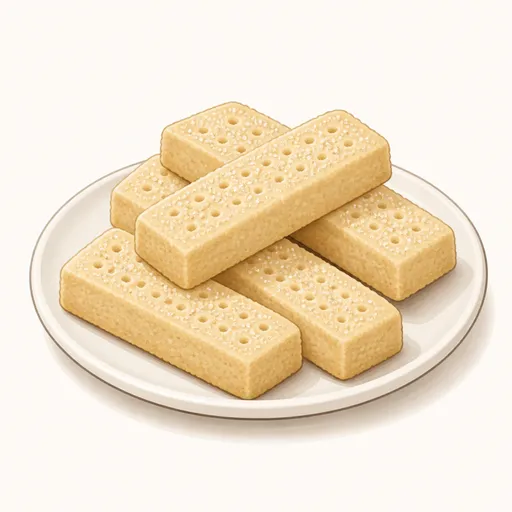
Shortbread, the crumbly Scottish butter cookie, is made from nothing more than butter, sugar and flour, yet it's rich with buttery flavor and has a sandy texture that melts in your mouth. The dough is pressed into a square pan, baked low and slow until pale golden, then cut into elegant fingers.
- Difficulty
- Very easy
- Prep
- 15 min
- Cook
- 38 min
- Rising or chilling
- 30 min
- Total time
- 1 hr 23 min
- Method
- Oven-baked
Ingredients
Shortbread dough
Sugar topping
Instructions
Step 1
Preheat the oven to 160°C and line a 20 cm square pan with parchment paper so it covers the bottom and hangs over two opposite sides. The low temperature bakes the shortbread through while keeping its signature pale color. The pan is ready when the paper lies flat with no creases in the corners.
Step 2
Put 225 g softened unsalted butter in a bowl with 100 g superfine sugar and 2 g salt, and press firmly with a flat spatula for about two minutes. Shortbread doesn't need to be beaten fluffy; you just want the butter and sugar to come together so the cookies are dense and crumbly rather than puffy. The mixture is ready when it's smooth like thick cream and the sugar is evenly mixed in.
Step 3
Sift 270 g all-purpose flour and 45 g cornstarch into the bowl, stir with the flat spatula, then switch to your hands and squeeze gently until the dough comes together. Cornstarch reduces the gluten, so the shortbread melts tenderly instead of being hard and crunchy. The dough is ready when it just holds together, feels soft and there's no dry flour left at the bottom of the bowl.
Step 4
Spread the dough evenly in the pan, then use the flat bottom of a glass to press it down firmly and evenly all over. Pressing firmly keeps the shortbread from crumbling when you cut it, and an even thickness helps it bake evenly. It's ready when the top is flat, the corners are filled and the dough is about 1.5 cm thick.
Step 5
Prick even rows of holes across the dough with a fork, sprinkle 10 g superfine sugar over the top and refrigerate the pan for about 20 minutes. The holes let steam escape so the shortbread doesn't puff, and the chilled dough keeps sharp edges. The pan is ready when the dough has firmed up and the sugar is stuck fast to the surface.
Step 6
Bake on the middle rack at 160°C for about 35 to 40 minutes. Slow baking lets the butter soak evenly through the flour and dries the shortbread crisp all the way to the center. It's done when the edges turn pale golden, the top looks dry and it feels firm to the touch.
Step 7
As soon as the pan comes out of the oven, use a sharp knife to cut the shortbread into sixteen long fingers along the pricked lines, leaving it in the pan. Shortbread only cuts cleanly while warm; once cool, it's very crisp and crumbles easily. The cuts are right when they go all the way to the bottom and the fingers are all the same size.
Step 8
Let the shortbread cool completely in the pan for about 30 minutes, then lift it out by the edges of the paper and break the fingers apart along the cuts. Cooling in the pan lets the butter set and the texture firm up. It's ready when the fingers separate easily, the edges are straight and a test bite is sandy and crisp.
Equipment
- Oven
- Square pan
- Parchment paper
- Mixing bowl
- Spatula
- Sieve
- Kitchen scale
- Wire cooling rack
Tips
- Use the best butter you can find, since butter is the star flavor of shortbread.
- You can swap the cornstarch for rice flour to give the shortbread a slightly gritty, more traditional crunch.
- Add a little grated lemon zest or finely ground Earl Grey tea leaves to the dough for a fragrant twist.
Storage
Kept in an airtight tin in a cool, dry place, shortbread stays crisp for up to two weeks, and the buttery flavor gets even richer after a day or two. You can also freeze the raw dough for up to three months.
Common problems and how to fix them
- The shortbread puffed up and cracked on top.
- The dough wasn't pricked closely enough or the oven was too hot. Prick the whole surface well and check your oven temperature with an oven thermometer.
- The shortbread crumbles when cut.
- It cooled before cutting or the dough wasn't pressed firmly enough. Next time, press the dough very firmly into the pan and cut as soon as it comes out of the oven.
This recipe is based on the common ratios for this bake and is written entirely in our own words.