Molasses cookies
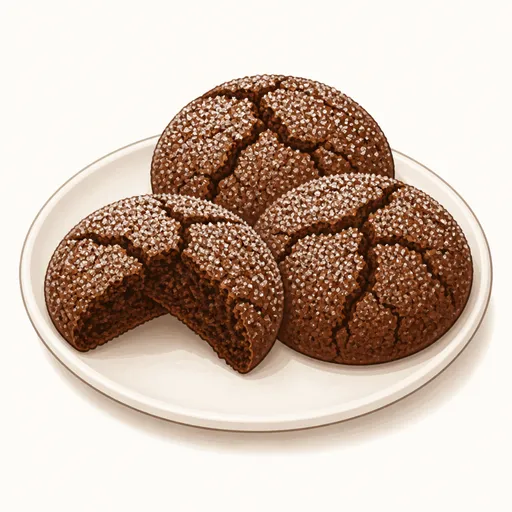
Molasses cookies are big, thick, chewy American cookies wrapped in a crunchy sugar coating, with tops that crackle like tree bark. Plenty of molasses and melted butter make the inside moist, chewy and deeply caramel-like, with the cozy warmth of cinnamon and ginger. They are easy to make and a big favorite on chilly days.
- Difficulty
- Very easy
- Prep
- 20 min
- Cook
- 11 min
- Rising or chilling
- 1 hr 10 min
- Total time
- 1 hr 41 min
- Method
- Oven-baked
Ingredients
Cookie dough
Sugar coating
Instructions
Step 1
Put 170 g unsalted butter in a small saucepan, melt it over low heat, then take it off and let it cool for about five minutes. Melting the butter instead of creaming it is what gives these cookies a dense, chewy center rather than a cakey one. The butter is right when it has fully melted and is just warm, not hot to the touch.
Step 2
Pour the warm butter into a large bowl, add 150 g brown sugar, 120 g molasses and 50 g egg, and whisk for about one minute. Whisking by hand is just enough to emulsify the butter and molasses without beating in too much air. The mixture is right when it is glossy, deep brown and has no butter floating on top.
Step 3
Sift 300 g all-purpose flour with 8 g baking soda, 4 g ground cinnamon, 4 g ground ginger, 1 g ground cloves and 3 g salt into another bowl. There is quite a lot of baking soda for the amount of flour, so sift it very evenly to keep the cookies from tasting soapy. The mixture is right when it is fine, loose and an even color.
Step 4
Add the dry ingredients to the molasses mixture and fold with a spatula until no dry flour remains. The dough will be very soft and sticky, which is normal for this kind of chewy cookie. It is right when it is uniform, slightly glossy and has no white streaks of flour.
Step 5
Cover the bowl tightly with plastic wrap and chill the dough in the refrigerator for about one hour. Cold dough lets the butter firm up, so the cookies stay thick instead of spreading thin. The dough is right when it is firm enough to roll into balls without sticking to your hands.
Step 6
Preheat the oven to 175 degrees C and line a baking sheet with parchment paper. The oven needs to be hot enough for the tops to crack quickly while the centers stay soft. It is ready after about fifteen minutes of preheating.
Step 7
Scoop the dough into large balls of about two tablespoons each, roll them round, coat them in 60 g granulated sugar and set them on the sheet about six centimeters apart. Big balls make cookies that are thick and chewy in the middle, while the sugar forms a sweet, crunchy shell. The balls are right when they are evenly coated with no brown dough showing.
Step 8
Bake at 175 degrees C for about 9 to 11 minutes and take the cookies out while the centers still look a little wet. They keep cooking from the heat of the sheet, so pulling them early is how you keep the centers chewy. They are right when the edges are set, the tops are clearly cracked and the centers are puffed and soft.
Step 9
Leave the cookies on the hot baking sheet for about ten minutes before moving them to a wire rack. This rest lets the centers finish cooking and the cookies settle into lovely cracks. They are ready when they hold their shape when lifted and are soft and chewy inside when broken.
Equipment
- Oven
- Small saucepan
- Whisk
- Mixing bowl
- Spatula
- Sieve
- Kitchen scale
- Baking sheet
- Parchment paper
- Wire cooling rack
- Plastic wrap
- Refrigerator
Tips
- Use regular, mild-flavored molasses; thick blackstrap molasses is very bitter and will overpower the spices.
- Rolling the dough balls in coarse sugar gives a crunchier, more sparkly coating.
- You can freeze the shaped dough balls; when you want cookies, just roll them in sugar and bake for about two minutes longer.
Storage
The cookies stay soft and chewy in an airtight container at room temperature for about a week. You can tuck a slice of bread into the container to keep them moist so they don't dry out.
Common problems and how to fix them
- The cookies spread thin and lost their chewiness.
- The butter was too hot when mixed in, or the dough wasn't chilled long enough. Let the butter cool down a bit and chill the dough for at least one hour.
- The cookies are hard and dry once cooled.
- They were baked too long, so the centers cooked all the way through in the oven. Take them out sooner, while the centers still look wet.
This recipe is based on the common ratios for this bake and is written entirely in our own words.