Melting moments
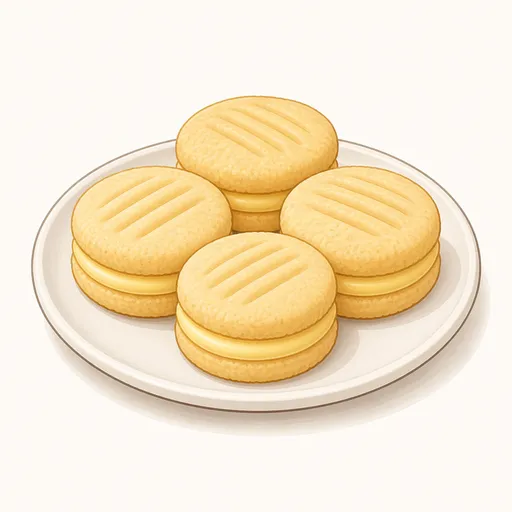
Melting moments are butter cookies from Australia and Britain, famous for being so tender they melt the moment they touch your tongue. The secret is plenty of butter plus custard powder, which makes them light, fine-textured and a soft creamy yellow. Two cookies are sandwiched with a lemon buttercream filling, for a rich sweetness balanced by a gentle tang.
- Difficulty
- Easy
- Prep
- 35 min
- Cook
- 17 min
- Rising or chilling
- 30 min
- Total time
- 1 hr 22 min
- Method
- Oven-baked
Ingredients
Cookie dough
Lemon buttercream filling
Instructions
Step 1
Preheat the oven to 160°C and line two baking sheets with parchment paper. These cookies need a low oven so they bake through while staying pale and meltingly tender. The oven is ready when the preheat light switches off and the temperature has held steady for a few minutes.
Step 2
Beat 250 g softened butter with 60 g powdered sugar and 5 g vanilla extract on medium speed for about four minutes. Beating for a while fills the butter with air bubbles, which is what makes the cookies light and quick to melt. The mixture is ready when it's almost white and as fluffy as whipped cream.
Step 3
Sift 225 g all-purpose flour and 60 g custard powder together into the bowl, then fold gently with a spatula until the dough comes together in a soft mass. Custard powder contains cornstarch, so it makes the cookies finer and more crumbly-tender than flour alone. The dough is ready when it's smooth, soft like modeling clay and doesn't stick to your hands.
Step 4
Roll the dough into balls about the size of a large grape, arrange them on the sheets about three centimeters apart, then dip a fork in flour and press it lightly on top of each ball. The fork flattens the cookies evenly and leaves a pretty striped pattern. They're ready when they're about one centimeter thick with clear fork marks.
Step 5
Bake on the middle rack at 160°C for 15 to 18 minutes, swapping the two sheets halfway through. The cookies should be just baked, not deeply golden, or they'll lose their melting tenderness. They're done when the bottoms are just turning straw-colored and the tops are dry and pale.
Step 6
Let the cookies cool on the sheets for about ten minutes, then gently move them to a rack until completely cool. They're very fragile while warm, so they need to rest on the sheet to firm up. They're ready when they no longer feel warm and don't break when lifted.
Step 7
Beat 60 g softened butter with 100 g powdered sugar until light and fluffy, then add 3 g lemon zest and 10 g lemon juice and beat for one more minute. The tang of the lemon tones down the sweetness of the filling so the cookies don't feel too rich. The filling is ready when it's smooth, fluffy and holds its shape on a spoon.
Step 8
Turn half the cookies upside down, spread or pipe a layer of filling about half a centimeter thick onto their flat sides, then top with the remaining cookies and press very gently. A light touch spreads the filling evenly to the edges without cracking the cookies. They're finished when a thin ring of filling shows around the edge and the two cookies line up neatly.
Equipment
- Oven
- Baking sheet
- Parchment paper
- Mixing bowl
- Hand mixer
- Spatula
- Sieve
- Kitchen scale
- Wire cooling rack
Tips
- If you don't have custard powder, you can use the same weight of cornstarch and add a little extra vanilla.
- Pair up cookies of roughly the same size before you spread on the filling.
- You can swap the lemon filling for passion fruit buttercream or vanilla buttercream, depending on your taste.
Storage
Filled cookies keep for about three days in an airtight container somewhere cool; in hot weather, store them in the fridge and leave them out for ten minutes before eating. Unfilled cookies keep for a week at room temperature.
Common problems and how to fix them
- The cookies spread and lost their fork marks.
- The butter was too soft or the kitchen was too warm. Put the tray of shaped cookies in the fridge for about fifteen minutes before baking.
- The cookies are hard instead of melting in your mouth.
- The butter wasn't beaten fluffy enough or the dough was overworked. Next time, beat the butter thoroughly and mix in the flour only until it just comes together.
This recipe is based on the common ratios for this bake and is written entirely in our own words.