Lavender shortbread
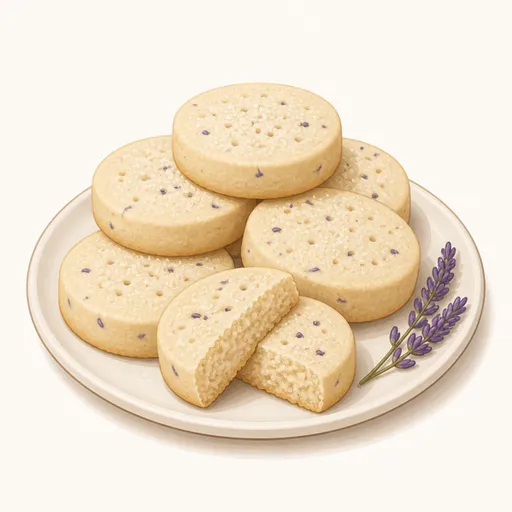
Shortbread is a traditional Scottish butter cookie made from just butter, sugar and flour, so the butter flavor shines through and the texture melts in your mouth. A little finely ground dried lavender adds a gentle fragrance like summer meadow flowers, perfect for nibbling with afternoon tea.
- Difficulty
- Very easy
- Prep
- 20 min
- Cook
- 22 min
- Rising or chilling
- 30 min
- Total time
- 1 hr 12 min
- Method
- Oven-baked
Ingredients
Dough
Sugar for sprinkling
Instructions
Step 1
Put 5 g dried lavender in a mortar with 90 g superfine sugar and pound it, or pulse it in a grinder for a few seconds. The sugar crystals rub against the flowers, releasing their oils and spreading them evenly through the sugar. The lavender sugar is ready when it's clearly fragrant and no whole buds larger than a grain of broken rice remain.
Step 2
Beat 200 g softened unsalted butter with the lavender sugar, a pinch of salt and 3 g grated lemon zest, if using, on medium speed for about three minutes. Beating the butter just enough keeps the shortbread tender without puffing up and losing its shape. The mixture is ready when it's smooth, slightly paler and as soft as thick cream.
Step 3
Sift 260 g all-purpose flour and 40 g cornstarch into the butter, then use a spatula to press and gather the dough rather than stirring hard. Cornstarch reduces the gluten so the cookies melt right on your tongue. The dough is ready when it squeezes together into a soft mass that doesn't stick to your hands and shows no white streaks of flour.
Step 4
Press the dough into a flat disc about 2 cm thick, wrap it in plastic wrap and refrigerate for about 30 minutes. Chilling the butter again helps the cookies keep sharp edges in the oven. The dough is ready when it feels firm but still takes a light fingertip impression.
Step 5
Preheat the oven to 160°C and line a baking sheet with parchment paper. Shortbread needs low heat to bake evenly through while staying an ivory color. The oven is ready when an oven thermometer reads exactly 160°C.
Step 6
Roll the dough between two sheets of parchment to about 8 mm thick, cut out shapes with a cutter, set them 2 cm apart on the sheet and prick the tops a few times with a fork. Pricking lets steam escape so the tops stay flat. Each cookie is right when it's evenly thick, with neat edges, and doesn't warp when you lift it onto the sheet.
Step 7
Bake at 160°C for 18 to 22 minutes, until the bottom edges just begin to turn pale golden. Shortbread is best while still light in color; overbaking will drive off the floral aroma. It's done when the tops are dry, the bottom edges are straw-colored and a buttery aroma fills the kitchen.
Step 8
Sprinkle 15 g sugar over the cookies while they're still hot, leave them on the sheet for five minutes, then move them to a rack. Hot cookies hold on to the sugar and need a few minutes to firm up. They're finished when completely cool, crisp and tender in your hand and snap with a light crack when broken.
Equipment
- Oven
- Baking sheet
- Parchment paper
- Mixing bowl
- Spatula
- Rolling pin
- Cookie cutter
- Kitchen scale
- Plastic wrap
Tips
- Only use food-grade dried lavender, as decorative flowers may have been treated with chemicals.
- The small amount of lavender is intentional; using more can easily make the cookies taste soapy.
- You can press the dough into a square pan, bake it as one slab and cut it into fingers while still warm.
Storage
Store the shortbread in a cookie tin or sealed glass jar in a dry place, and it will stay crisp and tender for about two weeks. Unbaked dough can be wrapped tightly and frozen for up to two months.
Common problems and how to fix them
- The shortbread is hard and tough instead of tender.
- The dough was kneaded or mixed too much, developing gluten. Only press the dough until it just comes together, then stop.
- The cookies spread and lose their shape in the oven.
- The butter was too soft or the dough wasn't chilled long enough. Put the cut cookies in the fridge for another fifteen minutes before baking.
This recipe is based on the common ratios for this bake and is written entirely in our own words.