Ladyfingers
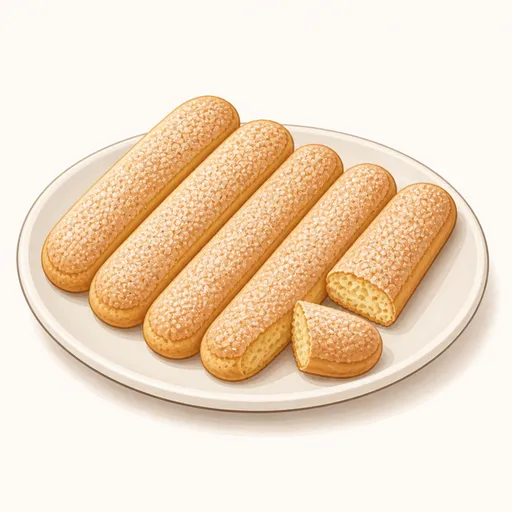
Ladyfingers, also called savoiardi, are little sponge cake fingers with a thin, crisp sugar crust and a crumb as light as a cloud. They're essential for tiramisu and charlotte, but they're also lovely on their own with a cup of tea, thanks to their gentle eggy sweetness.
- Difficulty
- Medium
- Prep
- 25 min
- Cook
- 12 min
- Rising or chilling
- 10 min
- Total time
- 47 min
- Method
- Oven-baked
Ingredients
Yolk mixture
Whipped egg whites
Dry ingredients
Powdered sugar for dusting
Instructions
Step 1
Set a rack in the middle of the oven and preheat it to 190°C, then draw parallel lines 9 cm long on the back of a sheet of parchment paper and use it to line a baking sheet. The guidelines help you pipe fingers of the same length. The sheet is ready when the paper is flipped so the lines face down and you can still see them clearly.
Step 2
Beat 72 g egg yolks with 35 g superfine sugar and 4 g vanilla extract on high speed for about three minutes. Well-beaten yolks make the ladyfingers airy and free of any eggy smell. The mixture is ready when it turns pale yellow, thick and falls in ribbons that pile up on themselves.
Step 3
In a clean bowl, whip 130 g egg whites with a pinch of salt until foamy, then gradually sprinkle in 65 g sugar and keep whipping for about five minutes. A stiff meringue is the framework that helps the fingers hold their shape when piped. The whites are ready when they're glossy and smooth, the peaks stand straight up and the bowl can be turned upside down without them sliding.
Step 4
Add the yolk mixture to the meringue, sift 85 g cake flour and 15 g cornstarch over the top in two additions, and fold very gently with a spatula. Ladyfinger batter has to be thick to hold its shape, so use as few strokes as possible. The batter is ready when no dry streaks remain but it's still airy and holds in a mound when scooped.
Step 5
Spoon the batter into a piping bag fitted with a round tip of about 1 cm, hold the bag at an angle and pipe fingers along the guidelines, 3 cm apart. Steady, even pressure keeps the fingers straight and the same thickness. Each finger is right when it's plump and round with neat ends and doesn't spread out.
Step 6
Sift 20 g powdered sugar evenly over the fingers, wait five minutes, then sift on a second layer. The sugar melts and dries again to form a crisp, pearly speckled crust. The surface is ready for the second layer when the first has melted into shiny dots.
Step 7
Bake at 190°C for 10 to 12 minutes, without opening the oven door for the first eight minutes. The fairly hot oven sets the outside quickly while the inside stays soft and spongy. They're done when they're pale golden, dry on top and spring back when pressed lightly.
Step 8
Let the ladyfingers cool on the parchment for about five minutes, then slide a thin knife gently underneath to lift them onto a rack. While still hot they're very soft and stick easily to the paper. They're finished when completely cool, with dry bottoms that release from the paper easily.
Equipment
- Oven
- Baking sheet
- Parchment paper
- Hand mixer
- Piping bag
- Sieve
- Spatula
- Mixing bowl
- Kitchen scale
Tips
- If you're making tiramisu, dry the ladyfingers for another ten minutes at 100°C so they're firmer and can soak up coffee without falling apart.
- Get your piping bag and baking sheet ready before you mix the batter, because it loses air the longer it sits.
- You can pipe the batter into rounds to make bases for a charlotte.
Storage
In an airtight container at room temperature, ladyfingers stay crisp for about a week. If they soften from humidity, just dry them again in a warm oven for a few minutes.
Common problems and how to fix them
- The fingers spread out and turn flat.
- The meringue wasn't stiff enough or the batter was overmixed. Whip the whites to stiff, upright peaks and fold quickly, stopping as soon as the dry flour disappears.
- The tops don't have a speckled crust.
- The powdered sugar layer was too thin, or you skipped the wait between the two dustings. Dust more generously and wait until the first layer has fully melted.
This recipe is based on the common ratios for this bake and is written entirely in our own words.