Florentines
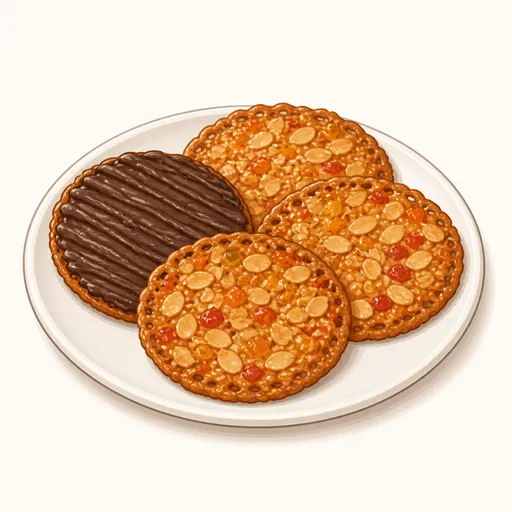
Florentines are thin, lacy, crisp cookies made from sliced almonds and candied orange peel bound in a honey butter caramel. The underside is coated in dark chocolate and marked with wavy lines, creating an elegant combination of crunch, bittersweet chocolate and fragrant orange.
- Difficulty
- Medium
- Prep
- 25 min
- Cook
- 12 min
- Rising or chilling
- 30 min
- Total time
- 1 hr 7 min
- Method
- Oven-baked
Ingredients
For the honey butter caramel
For the almonds and fruit
For the chocolate base
Instructions
Step 1
Heat the oven to 180°C and line two baking sheets with parchment paper or silicone baking mats. Florentines spread very thin and are sticky, so a good liner decides whether you can lift them off in one piece. The sheets are ready when the parchment lies flat and the oven is fully hot.
Step 2
Put 60 g unsalted butter, 100 g granulated sugar, 30 g honey, 60 g heavy cream and a pinch salt in a heavy-bottomed saucepan, cook over medium heat, stirring until the sugar dissolves, then let it boil for about two minutes more. Cooking it to about 115°C makes the caramel thick enough for the cookies to turn crisp as they cool. The mixture is ready when it's covered in dense, tiny bubbles and has turned a pale butterscotch color.
Step 3
Turn off the heat and immediately add 200 g sliced almonds, 60 g diced candied fruit such as orange peel, 3 g orange zest and 25 g all-purpose flour to the pan and stir well. A little flour helps the caramel cling to the nuts instead of running off in the oven. The mixture is ready when every almond slice is glossy with caramel.
Step 4
Drop small spoonfuls of the still-warm mixture onto the sheets, about six per sheet and at least eight centimeters apart, then flatten them with the back of a wet spoon. The cookies spread to twice their size in the oven, so they need lots of room. The portions are right when they're flat rounds just one layer of almonds thick.
Step 5
Bake at 180°C for 9 to 12 minutes, watching closely from the eighth minute since caramel changes color very quickly. The caramel needs to bubble and cook evenly for the cookies to be crisp rather than chewy. They're ready when they've spread into thin lace, are bubbling gently and are an even amber gold from edge to center.
Step 6
Right out of the oven, you can use a round cutter slightly larger than each cookie to nudge the edges into a neat circle, then let the cookies cool on the sheet for about fifteen minutes. Hot caramel is very soft and only hardens as it cools. They're ready when they lift easily off the paper and snap crisply when you break one.
Step 7
Finely chop 150 g dark chocolate, melt it over a water bath on low heat and stir until about two-thirds has melted, then take it off the heat and keep stirring until it's all melted. Melting gently helps the chocolate keep its shine and set quickly. The chocolate is ready when it's smooth, glossy and just a little warmer than your lips.
Step 8
Turn the cookies over, spread a thin layer of chocolate on the flat underside, draw wavy lines with the tines of a fork, then set them on parchment paper for about fifteen minutes to let the chocolate set. The chocolate adds a balancing bitterness and makes the cookies sturdier to hold. They're finished when the chocolate is dry and glossy and doesn't stick to your fingers.
Equipment
- Oven
- Small saucepan
- Spatula
- Kitchen scale
- Baking sheet
- Parchment paper
- Wire cooling rack
- Thermometer
Tips
- You can swap the candied orange peel for finely chopped dried cherries or dried cranberries for a pretty red color.
- Bake two test cookies first to check how much they spread and how long they take, then adjust the spacing for the following batches.
- If the mixture in the pan cools and stiffens, warm it over low heat for a few seconds and you can keep scooping.
Storage
Layer the cookies between sheets of parchment paper in an airtight container and keep them in a cool, dry place, where they stay crisp for about five days. Don't store them in the fridge, since the humidity makes the caramel soft and sticky and gives the chocolate a white bloom.
Common problems and how to fix them
- The cookies are chewy, stick to your teeth and aren't crisp.
- The caramel wasn't cooked long enough or the cookies weren't baked to full color. Boil the caramel for one more minute and bake until the cookies are an even amber.
- The cookies stuck to the sheet and broke when lifted.
- You lifted them while they were still too hot or the liner wasn't nonstick enough. Use a silicone mat or good-quality parchment paper and wait until the cookies have cooled completely before lifting them.
This recipe is based on the common ratios for this bake and is written entirely in our own words.