Chinese almond cookies
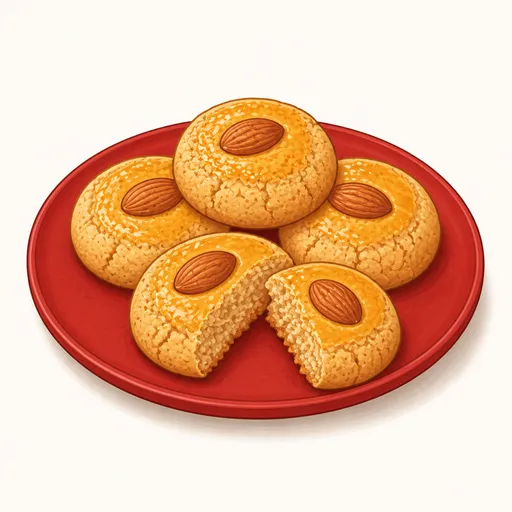
Chinese almond cookies are a beloved Lunar New Year treat in Chinese homes, said to symbolize gold coins and prosperity. Made with lard, they have a uniquely short, crumbly texture that melts the moment you bite in, with a strong almond aroma. Each cookie has a whole almond pressed into the center and is brushed with egg yolk for a shiny golden top.
- Difficulty
- Very easy
- Prep
- 25 min
- Cook
- 17 min
- Rising or chilling
- 30 min
- Total time
- 1 hr 12 min
- Method
- Oven-baked
Ingredients
For the dough
Almonds and egg yolk glaze
Instructions
Step 1
Beat 170 g room-temperature lard with 150 g superfine sugar for about two minutes, then add 50 g eggs and 6 g almond extract and beat until well blended. Lard creates the signature crumbly, short texture that butter struggles to match. The mixture is ready when it's white, smooth, light and free of sugar grains.
Step 2
Sift 250 g all-purpose flour, 100 g almond flour, 2 g baking soda, 3 g baking powder and 2 g salt into the lard mixture and mix with a spatula until the dough just comes together. The two leaveners make the tops crack slightly and keep the inside light and crisp. The dough is ready when it's soft, smooth and a little crumbly but presses together into a ball.
Step 3
Wrap the dough and refrigerate it for about thirty minutes to firm up. Cold lard helps the balls hold their round shape and keeps them from spreading too much in the oven. The dough is ready when you can roll it into balls without it sticking to your hands.
Step 4
Preheat the oven to 165°C and line two baking sheets with parchment paper. The low heat bakes the cookies evenly crumbly while keeping the tops a pale gold rather than dark brown. The oven is ready after about fifteen minutes of preheating.
Step 5
Roll the dough into balls about the size of a jujube, arrange them on the trays four centimeters apart, then press your thumb gently into the center of each to make a small dent. The dent holds the almond and helps the cookie spread out evenly. You're done shaping when the balls are all the same size and the edges have cracked slightly on their own.
Step 6
Beat 18 g egg yolks with a few drops of water, brush a thin layer over each ball of dough, then press one of the 36 g whole almonds firmly into each dent. The yolk gives the cookies a glossy golden top and keeps the almonds from falling off. You're done when the tops are evenly shiny and each almond sits securely in the center.
Step 7
Bake at 165°C for 15 to 18 minutes, swapping the two trays halfway through so the cookies bake evenly. The long enough bake dries the cookies crisp from the inside out. They're done when the tops are glossy gold, the edges are slightly cracked and the bottoms are golden brown.
Step 8
Leave the cookies on the trays for five minutes, then move them to a rack for about fifteen minutes more. Cookies made with lard are so crumbly that they break easily while hot. They're ready when they've cooled completely and smell richly of almond.
Equipment
- Oven
- Hand mixer
- Mixing bowl
- Spatula
- Sieve
- Kitchen scale
- Baking sheet
- Parchment paper
- Pastry brush
- Wire cooling rack
- Plastic wrap
- Refrigerator
Tips
- If you'd rather not use lard, you can substitute shortening or half butter and half shortening; the cookies will still be crumbly, but the flavor will be slightly different.
- Soak the almonds in warm water for five minutes before pressing them in so they don't burn in the oven.
- These cookies make a great Lunar New Year gift; pack them in a paper-lined tin to keep them intact.
Storage
Once completely cool, keep the cookies in an airtight container at room temperature, where they'll stay crisp and crumbly for about two weeks. Keep them away from damp places and the stove, since the lard can make them soft and change their flavor.
Common problems and how to fix them
- The cookies spread too wide and thin.
- The lard was too soft or the dough wasn't cold enough. Use lard at a cool room temperature and chill the shaped balls on the tray for another ten minutes before baking.
- The cookies are hard instead of crumbly and tender.
- The dough was worked too long or there wasn't enough fat. Weigh the lard precisely and mix only until the dough just comes together.
This recipe is based on the common ratios for this bake and is written entirely in our own words.