Alfajores
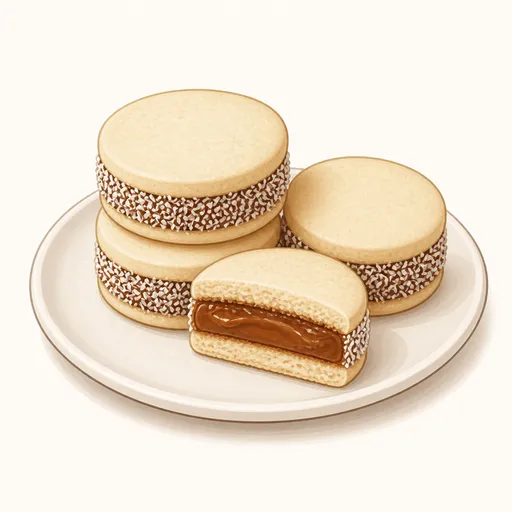
Alfajores are beloved sandwich cookies from Argentina and much of South America: two tender, melt-away cornstarch cookies hugging a layer of dulce de leche (milk slowly cooked with sugar until thick and golden brown). The edges get rolled in desiccated coconut, making a dainty little treat that is rich, gently sweet and dissolves the moment it touches your tongue.
- Difficulty
- Medium
- Prep
- 50 min
- Cook
- 11 min
- Rising or chilling
- 1 hr 15 min
- Total time
- 2 hr 16 min
- Method
- Oven-baked
Ingredients
Cornstarch cookies
Dulce de leche filling and coconut edges
Instructions
Step 1
Beat 200 g softened unsalted butter with 150 g granulated sugar for about three minutes, then add the 54 g egg yolks one at a time, followed by 5 g vanilla extract, 3 g lemon zest and 10 g brandy. The brandy and zest add a light aromatic backdrop that balances the deep sweetness of the caramel filling. The mixture is ready when it is fluffy, smooth and creamy yellow, with no gritty sugar left.
Step 2
Sift 300 g cornstarch, 200 g all-purpose flour, 8 g baking powder, 2 g baking soda and a pinch salt together into the butter bowl, then use your hands or a flat spatula to gently gather everything into a mass. The high proportion of cornstarch gives the cookies their soft, crumbly, almost powdery texture, just like traditional alfajores. The dough is ready when it is smooth, soft and no longer sticky; if it feels a little dry, squeeze it gently until it comes together.
Step 3
Press the dough into a flat disk, wrap it in plastic wrap and refrigerate for about forty-five minutes. A dough this rich in cornstarch is very delicate and can only be rolled and cut once it is cold and firm. It is ready when it feels firm but still holds a fingerprint when pressed.
Step 4
Heat the oven to 170°C and line two baking trays with parchment paper. Alfajores need a moderate oven so they bake through while staying ivory white instead of browning. The oven is ready after a full fifteen minutes of preheating.
Step 5
Dust your work surface with a little cornstarch, roll the dough about five millimeters thick, then cut rounds with a five-centimeter cutter and arrange them on the trays two centimeters apart. An even thickness helps all the rounds bake at the same rate and pair up neatly. You are done when you have an even number of rounds with clean, round edges.
Step 6
Bake at 170°C for 9 to 11 minutes, watching closely during the last few minutes. Overbaked cookies turn dry and lose their signature melt-in-your-mouth tenderness. They are done when the tops are still ivory, the bottoms are just turning pale golden and the surface feels dry to a light touch.
Step 7
Let the cookies sit on the tray for about five minutes, then gently move them to a wire rack and let them cool completely, about thirty minutes. Warm cookies are extremely fragile and would make the caramel filling runny. They are ready when fully cool and they stay flat when you lift them.
Step 8
Divide 450 g dulce de leche evenly over the flat side of half the cookies, about a heaping spoonful each, then top with the remaining cookies and twist gently so the filling spreads to the edges. Twisting instead of pressing hard keeps the cookies from cracking. The sandwiches are just right when the filling peeks out as a thin ring around the edge.
Step 9
Pour 40 g desiccated coconut onto a plate, hold each cookie like a wheel and roll its edge through the coconut. The coconut sticks to the exposed filling, decorating the cookies and keeping the caramel off your fingers. They are finished when the edges are evenly coated in a ring of white coconut.
Equipment
- Oven
- Hand mixer
- Mixing bowl
- Spatula
- Sieve
- Kitchen scale
- Rolling pin
- Cookie cutter
- Baking sheet
- Parchment paper
- Wire cooling rack
- Plastic wrap
- Refrigerator
Tips
- The dulce de leche should be as thick as whipped cream; if it is too loose, chill it for about thirty minutes before spreading.
- The cookies taste best after resting overnight, as the caramel filling slowly softens them so they melt even more evenly.
- For the much-loved chocolate-coated version, dip the filled cookies in melted dark chocolate.
Storage
Filled cookies keep in an airtight container in a cool, dry place for about five days, or in the fridge for up to a week. If you store them chilled, let them sit at room temperature for fifteen minutes before serving so the filling softens again.
Common problems and how to fix them
- The dough keeps cracking as you roll it.
- The dough is too cold or a little short on moisture. Let it warm up for a few minutes, knead it gently until pliable again and roll it between two sheets of parchment paper.
- The filling oozes out of the cookies.
- The cookies were still warm or the dulce de leche was too runny. Wait until the cookies are completely cool and chill the filling until thick before sandwiching.
This recipe is based on the common ratios for this bake and is written entirely in our own words.